The food industry is continuously evolving as manufacturers look for better ways to improve product quality, ingredient performance, stability, and formulation flexibility. As consumers increasingly seek functional, fortified, and nutrition-focused foods, formulators are working with ingredients that may be sensitive to moisture, oxygen, heat, light, processing conditions, or interactions with other components.
This is where microencapsulated ingredients are becoming increasingly relevant. By providing a protective structure around sensitive active components, microencapsulation offers manufacturers another approach to managing ingredient handling, stability, dispersion, and formulation challenges.
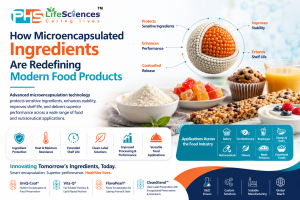
Microencapsulation provides a technology-based approach for surrounding an active ingredient with a protective coating or matrix. Depending on the ingredient and application, this can help manage exposure to environmental conditions, improve handling characteristics, support dispersion, and influence ingredient release.
From vitamins and nutrients to flavors, oils, enzymes, and other functional components, microencapsulated food ingredients are being explored across a wide range of modern food formulations.
What Are Microencapsulated Ingredients?
Microencapsulated ingredients are active food ingredients that are surrounded by a coating material or carrier system. The encapsulating material can be selected according to the ingredient’s characteristics and the requirements of the final application.
The core ingredient may be a vitamin, mineral, flavor, oil, nutrient, enzyme, or other functional component, while the outer layer provides a physical barrier between the active ingredient and its surrounding environment.
This approach is commonly referred to as food ingredient encapsulation or microencapsulation in food. The coating can be designed to influence how the active component interacts with the surrounding formulation.
The purpose is not simply to create a smaller particle. Instead, microencapsulated ingredients can be designed to influence how an ingredient behaves during processing, storage, handling, and consumption.
For food manufacturers, this can create additional flexibility when developing products where conventional ingredient formats may present challenges. The appropriate format depends on the active component, coating system, processing conditions, storage environment, and final product requirements.
Why Ingredient Stability Matters in Modern Food
Ingredient stability is an important consideration throughout the food product lifecycle. Exposure to oxygen, moisture, heat, light, and other formulation components can affect the performance of certain sensitive ingredients.
For example, some vitamins, flavors, oils, and active nutritional components may require additional protection during processing and storage. Maintaining food ingredient stability can therefore be an important part of formulation development.
When an ingredient becomes unstable, several factors may need to be considered, including potency, sensory characteristics, appearance, dispersion, and overall product consistency.
This is one reason manufacturers are exploring encapsulated ingredients as part of their formulation strategies. In suitable applications, microencapsulated ingredients may help provide a protective barrier around sensitive components and support more consistent ingredient performance.
By providing a protective matrix around a sensitive ingredient, encapsulation may help reduce direct exposure to specific environmental factors. The exact level of protection depends on the active ingredient, encapsulating material, processing method, dosage, packaging, and final food system.
How Microencapsulation Works
The basic concept behind microencapsulation technology for food ingredients involves combining an active ingredient with a suitable coating or carrier material.
The active component forms the core, while the coating surrounds or incorporates it within a protective structure. Different technologies can be selected depending on the physical and chemical properties of the ingredient and the intended application.
The encapsulation process can influence:
- Particle characteristics
- Ingredient protection
- Dispersion
- Flowability
- Handling
- Compatibility
- Release characteristics
- Processing performance
- Storage behavior
Because different ingredients have different requirements, there is no single encapsulation method that works for every food application.
The formulation objective, processing conditions, storage environment, and desired finished-product characteristics all need to be considered when selecting an appropriate food ingredient technology. These factors also determine whether microencapsulated ingredients are suitable for a particular product development project.
A successful encapsulation strategy therefore begins with understanding the active ingredient and the environment in which it will be used.
Key Benefits of Microencapsulation in Food
One of the major benefits of microencapsulation in food is the ability to manage sensitive ingredients more effectively within complex formulations.
1. Improved Ingredient Protection
Certain active ingredients can be sensitive to environmental exposure. Encapsulation can create a physical barrier that may help protect the ingredient during processing and storage.
This can be particularly relevant for microencapsulated vitamins, oils, flavors, and other sensitive components. Depending on the formulation, microencapsulated ingredients may provide an additional approach to managing exposure to moisture, oxygen, heat, or light.
The degree of protection depends on the encapsulation system and should be evaluated under actual application and storage conditions.
2. Better Handling Characteristics
Some ingredients may have properties that make them difficult to handle, mix, or incorporate into dry formulations.
Encapsulation can alter the physical characteristics of an ingredient, potentially improving flowability, handling, and incorporation into a formulation.
This can be particularly useful for powdered food systems where consistent dosing and mixing are important.
3. Improved Dispersion
Uniform ingredient distribution is important when a product contains a relatively small quantity of an active ingredient.
Well-designed encapsulated food ingredients can support more consistent dispersion, depending on particle properties and the formulation system. In some applications, microencapsulated ingredients can therefore provide a practical format for incorporating active components into complex food matrices.
Good dispersion can also support more consistent distribution of functional or nutritional ingredients throughout the finished product.
4. Reduced Interaction With Other Ingredients
Certain active components may interact with other ingredients in a formulation. Encapsulation can provide a degree of separation between the active ingredient and the surrounding matrix.
This can be useful when developing complex products containing multiple functional or nutritional components.
For example, an encapsulated ingredient may be evaluated when direct interaction with moisture, oxygen, minerals, fats, or other components presents a formulation consideration.
5. Controlled Ingredient Release
Some encapsulation systems can be designed to influence how an ingredient is released under specific conditions.
This creates opportunities for controlled-release food ingredients, although the desired release profile depends on the coating material, particle structure, processing conditions, and final application.
Release characteristics should be evaluated according to the intended product and performance requirements rather than assumed solely from the encapsulation format.
Applications of Microencapsulation in Food
The applications of microencapsulation in food continue to expand as manufacturers develop more sophisticated products. Microencapsulated ingredients can be evaluated across different food categories depending on their characteristics and the intended formulation objective.
Functional Foods
Functional foods often contain vitamins, minerals, botanical components, probiotics, or other nutritional ingredients. Some of these components may require protection or improved formulation compatibility.
Using functional food ingredients in encapsulated formats can provide formulators with additional options for incorporating sensitive actives.
The selection of an encapsulated format may depend on the active ingredient, target dosage, processing conditions, and final product characteristics.
Beverages
Beverage systems can present unique challenges because ingredients need to disperse effectively within a liquid environment.
Certain encapsulated ingredients can be developed to support dispersion, stability, and formulation requirements depending on the beverage system. The use of microencapsulated ingredients may also be considered when ingredient protection or physical compatibility is an important formulation requirement.
For beverage manufacturers, factors such as solubility, particle behavior, sedimentation, appearance, and sensory characteristics may need to be evaluated.
Bakery Products
Bakery formulations involve mixing, heating, and storage conditions that can influence ingredient performance.
Encapsulated ingredients may be considered when manufacturers want to incorporate sensitive nutritional or functional components into bakery products while managing processing-related challenges.
The encapsulation format may be selected according to the baking process, ingredient stability requirements, desired distribution, and finished-product characteristics.
Dairy and Nutrition Products
Fortified dairy products, nutritional foods, and specialized formulations may require precise incorporation of vitamins and other active components.
Microencapsulated nutrients can provide another format for managing sensitive ingredients within these product categories.
The objective is to balance active ingredient delivery with the physical, chemical, sensory, and processing requirements of the finished product.
Confectionery and Snack Foods
Flavors, oils, colors, vitamins, and other functional components can be incorporated into confectionery and snack applications using different encapsulation approaches.
The appropriate technology depends on the ingredient and the required sensory, processing, and storage characteristics.
Encapsulation may be considered where manufacturers need to manage ingredient interactions, improve handling, or influence release behavior.
Microencapsulated Vitamins and Nutrients
Vitamins are an important area for encapsulation technology because some vitamins can be sensitive to environmental conditions.
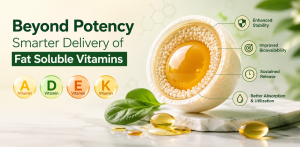
Microencapsulated vitamins can be designed to provide additional protection and improve their suitability for specific food and nutritional applications.
Fat-soluble vitamins are one example where ingredient format can be particularly relevant. Their dispersion, stability, and compatibility may need to be considered carefully when incorporated into different food systems.
Similarly, microencapsulated nutrients can offer formulation flexibility when manufacturers need to incorporate active nutritional components into complex products.
The objective is to select an ingredient format that aligns with the product’s processing conditions, storage requirements, dosage, and finished-product specifications. In this context, microencapsulated ingredients can serve as one option within a broader ingredient-selection strategy.
The Role of Microencapsulation in Food Ingredient Stability
Food ingredient stability is not determined by the ingredient alone. It can also depend on the surrounding formulation, processing conditions, packaging, moisture exposure, temperature, oxygen, and storage duration.
This means manufacturers need to evaluate ingredient performance within the complete food system.
Microencapsulated ingredients can contribute to this strategy by placing a protective layer around the active component.
However, encapsulation should not be considered a universal solution. Formulators should evaluate the stability of the active ingredient, coating material, particle characteristics, processing environment, and final application before selecting a specific encapsulation system.
This application-focused approach can help manufacturers identify the most suitable encapsulation technology in the food industry for their individual product requirements.
Stability testing under relevant processing and storage conditions remains an important part of formulation development.
How Encapsulation Supports Modern Food Formulation
Modern food products often contain multiple ingredients with different physical and chemical characteristics.
A formulation may need to balance nutrition, sensory quality, processing performance, stability, appearance, and shelf-life requirements.
In this environment, encapsulated food ingredients can provide additional formulation flexibility.
For example, a sensitive active may require protection, while a flavor may need to be managed for controlled release. An oil-based ingredient may require improved dispersion, while a nutritional component may need better compatibility with a dry powder system.
These different requirements demonstrate why food ingredient encapsulation is increasingly viewed as a formulation tool rather than simply a processing technique. For suitable applications, microencapsulated ingredients can help formulators approach these challenges through a purpose-designed ingredient format.
Why Encapsulation Technology Matters for Manufacturers
For food manufacturers, ingredient selection is closely connected to product development efficiency and finished-product performance.
Traditional ingredient formats may work effectively in some applications but create challenges in others. Encapsulation provides another format that can be evaluated when conventional approaches do not provide the desired characteristics.
The potential advantages of microencapsulated ingredients can include improved protection, handling, dispersion, compatibility, and application flexibility.
However, manufacturers should assess the complete ingredient system rather than focusing on encapsulation alone.
Important evaluation parameters can include:
- Active ingredient concentration
- Encapsulation efficiency
- Particle size
- Moisture content
- Stability
- Dispersion
- Processing tolerance
- Storage performance
- Compatibility with other ingredients
- Sensory impact
- Finished-product requirements
A systematic approach can help ensure that the selected ingredient format is suitable for the intended application.
PHS LifeSciences and Encapsulation Technology
PHS LifeSciences focuses on application-oriented ingredient technologies designed to address formulation and ingredient-performance requirements.
Its encapsulation approach includes solutions for sensitive and functional ingredients used across food and nutritional applications.
The company’s Vita-Q® technology is an example of an encapsulation platform developed around the stabilization and improved water solubility of selected fat-soluble ingredients.
Such technologies demonstrate how microencapsulation solutions can be developed around specific ingredient and application requirements rather than relying on a one-size-fits-all approach.
For manufacturers evaluating microencapsulated ingredients, the focus should remain on how the ingredient format performs within the intended product, processing environment, and storage conditions.
What Manufacturers Should Evaluate
Before selecting microencapsulated food ingredients, manufacturers should define the specific formulation challenge they are trying to address.
Key questions may include:
- Is the active ingredient sensitive to heat, moisture, oxygen, or light?
- Does the ingredient need improved dispersion?
- Is compatibility with other formulation components a concern?
- What processing conditions will the ingredient experience?
- What are the expected storage conditions?
- Is controlled release required?
- What dosage and active concentration are needed?
- Will the encapsulation system affect taste, texture, color, or appearance?
Answering these questions can help formulators identify the most appropriate ingredient format and technology. It can also help determine whether microencapsulated ingredients are appropriate for the specific product and processing environment.
The Future of Microencapsulated Ingredients
As food formulations become more specialized, the demand for technologies that support ingredient performance is expected to remain an important area of development.
The future of microencapsulated ingredients is likely to involve increasingly application-specific solutions designed around stability, dispersion, compatibility, controlled release, and nutritional delivery requirements.
Advances in encapsulation materials and processing technologies may also create opportunities for incorporating a wider range of sensitive and functional ingredients into modern food products.
For manufacturers, the key opportunity lies in matching the right encapsulation approach with the right formulation challenge. This requires understanding both the active ingredient and the conditions it will encounter throughout processing and storage.
FAQs
What are microencapsulated ingredients?
Microencapsulated ingredients are active food ingredients surrounded by a protective coating or matrix. The technology can be used to manage ingredient stability, handling, dispersion, compatibility, and release characteristics.
What are the benefits of microencapsulation in food?
The potential benefits include protection of sensitive ingredients, improved handling, better dispersion, reduced interaction with other components, and controlled release depending on the encapsulation system.
Which ingredients can be microencapsulated?
A wide range of ingredients can be considered for encapsulation, including vitamins, nutrients, flavors, oils, enzymes, and other functional components. The appropriate approach depends on the ingredient and application.
Why is microencapsulation important for food manufacturers?
Microencapsulation can provide an alternative ingredient format for addressing formulation challenges related to stability, processing, dispersion, compatibility, and storage. Microencapsulated ingredients can therefore be evaluated as part of an application-specific formulation strategy.
How does microencapsulation improve food ingredient stability?
Encapsulation can surround an active ingredient with a protective matrix, which may help reduce exposure to certain environmental conditions. Actual performance depends on the ingredient, encapsulation system, processing conditions, and final application.
Conclusion
The development of modern food products increasingly requires more than simply selecting individual ingredients. Manufacturers need to consider how ingredients behave throughout processing, storage, and the final product lifecycle.
Microencapsulated ingredients offer a technology-based approach for managing some of these challenges by providing protection, improving handling and dispersion, and supporting formulation flexibility.
From microencapsulated vitamins and nutrients to flavors, oils, and other functional components, encapsulation technology has applications across a broad range of food categories.
As the food industry continues to focus on functionality, stability, nutrition, and product innovation, microencapsulation in food can play an increasingly relevant role in modern ingredient development.
For manufacturers exploring advanced encapsulated ingredient solutions, the most effective approach is to evaluate ingredient technology according to the specific requirements of the formulation, processing environment, and finished product.