International Tea Day 2026: Solving Flavour and Stability Challenges in Modern Tea Formulations
Introduction
Tea is one of the simplest products to describe and one of the more interesting products to formulate.
At first glance, a tea product may need little more than tea, water and flavour. But as tea moves into instant powders, flavoured blends, ready-to-drink beverages and functional formulations, the ingredient system becomes considerably more complex. Flavours need to remain stable through processing and storage, functional ingredients need to work within the same formulation, and the final product still needs to deliver the sensory profile developed at the formulation stage.
For product developers, this creates a very practical challenge: how do you make an ingredient perform consistently after it leaves the laboratory and enters a real formulation?
That question is particularly relevant to flavour systems. A flavour that performs well during initial trials may behave differently when exposed to heat, moisture, oxygen, processing conditions or interactions with other ingredients.
This is where microencapsulation becomes a useful formulation approach.
On International Tea Day 2026, tea innovation is therefore not only about creating new flavour combinations. It is also about solving the ingredient-performance challenges that determine whether those concepts work in the finished product.
When the Flavour Is Right in the Lab but Changes in the Final Product
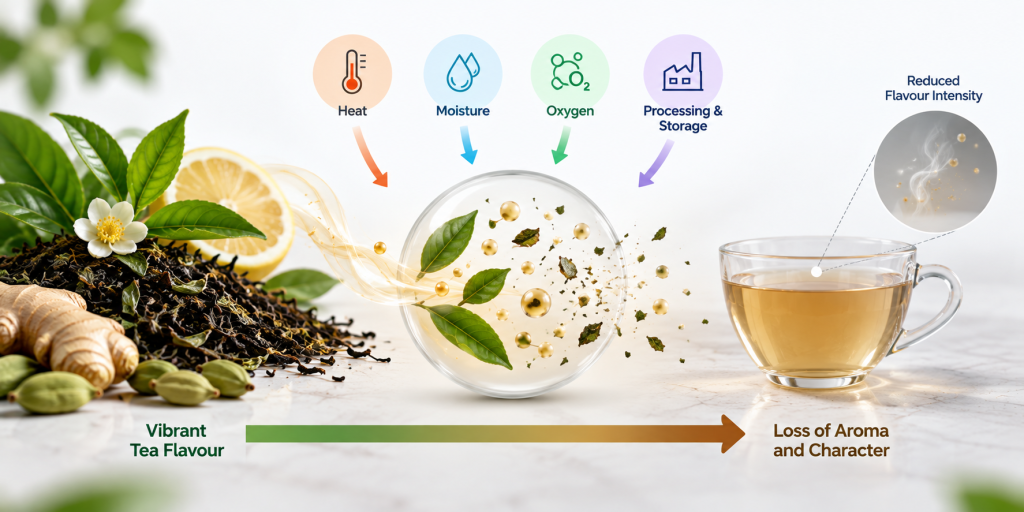
One of the most frustrating situations for a beverage formulator is seeing a flavour perform beautifully during initial development, only to find that the finished product does not deliver the same sensory experience after processing or storage.
The reason is often not the flavour itself. Many flavour components are sensitive to the environment around them. Heat, moisture and oxygen can influence flavour stability, while interactions with other formulation components may alter the way the flavour performs.
In a dry tea premix, for example, the flavour has to remain suitable for blending and storage. In an RTD beverage, it has to remain compatible with the liquid matrix and the relevant processing conditions. In a functional tea, the flavour may also have to work alongside ingredients that introduce bitterness, odour or other unwanted sensory characteristics.
The result can be a gradual reduction in flavour intensity or a change in the intended sensory profile.
For manufacturers, this is more than a taste issue. If the flavour profile changes between development and the finished product, maintaining consistency across production batches and shelf life becomes more difficult.
Simply increasing the flavour dosage does not always address the underlying problem. The more fundamental question is whether the flavour has been provided in an ingredient format that can withstand the demands of the formulation.
This is where microencapsulation can provide a different approach.
The Problem: Sensitive Flavours Are Exposed to the Formulation
In a conventional flavour system, flavour components are directly exposed to their surrounding environment. During manufacturing and storage, that exposure can contribute to volatility, degradation or interaction with other components of the formulation.
The challenge becomes particularly relevant as tea products move into more complex formats.
An instant tea powder may encounter moisture and oxygen during processing, filling and storage. An RTD tea may experience thermal processing before reaching the consumer. A functional tea may contain caffeine, vitamins, minerals, amino acids or other active ingredients that introduce additional formulation and sensory considerations.
This means the formulator is no longer asking only, “Which flavour should we use?”
The more important question becomes: “How do we make this flavour perform under the conditions of the final product?”
That shift—from flavour selection to ingredient performance—is central to the role of encapsulation.
The Solution: Give the Flavour a Protective Matrix
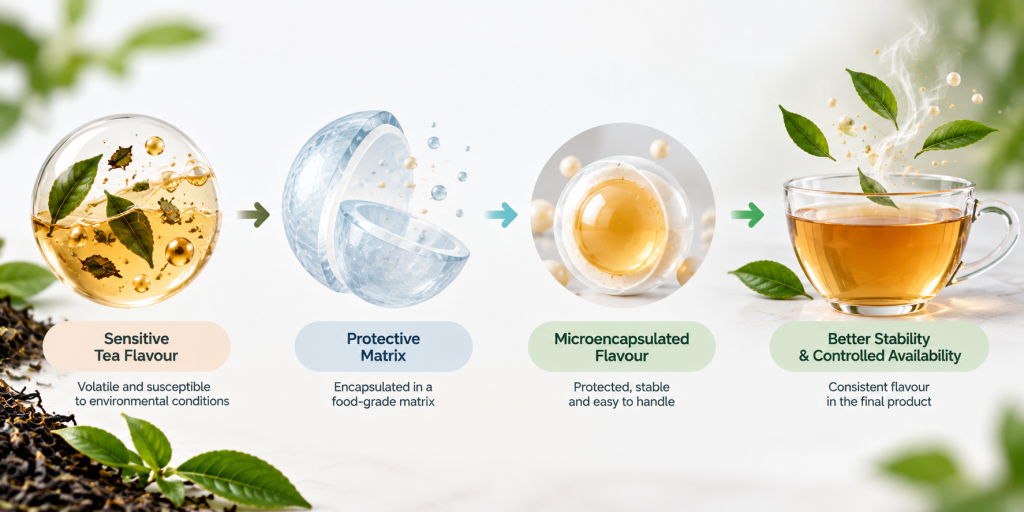
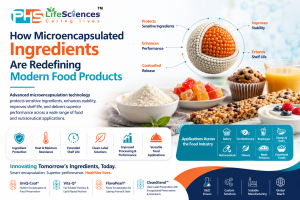
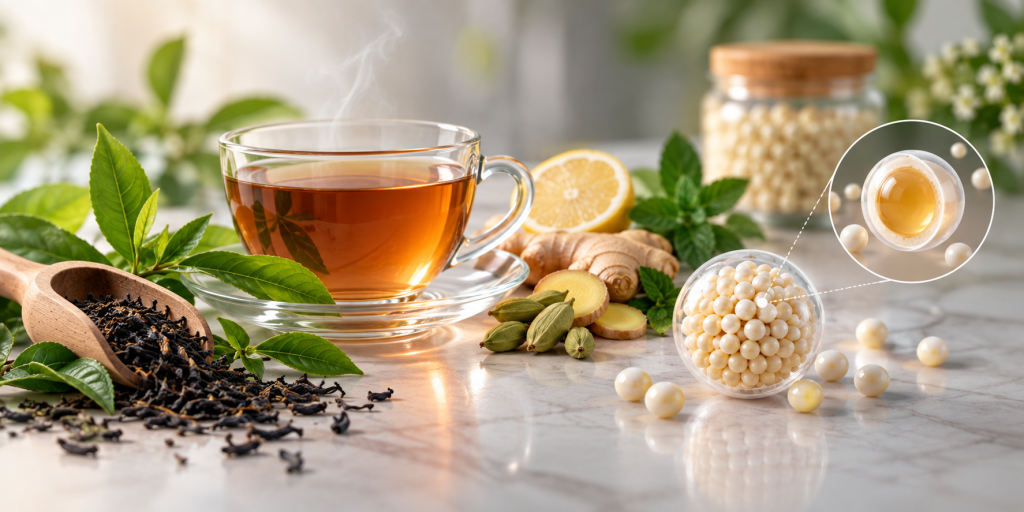
Microencapsulation incorporates the flavour within a protective matrix rather than leaving the sensitive flavour components completely exposed.
The matrix can provide a physical barrier between the flavour and some of the surrounding formulation and environmental conditions. Depending on the encapsulation system and application, this can support flavour stability, handling, dispersion and retention.
The important point is that encapsulation is not simply about putting a flavour inside a coating.
It is about creating an ingredient format that is better suited to the environment in which the ingredient needs to function.
For a dry tea premix, the focus may be on maintaining flavour retention and achieving uniform incorporation into the powder. For an RTD beverage, dispersion, compatibility and flavour retention under processing and storage conditions may become more important.
The technology therefore needs to follow the application.
The Problem: Functional Ingredients Can Create a Sensory Challenge
Tea is increasingly being used as a base for functional formulations. Once ingredients such as caffeine, amino acids, vitamins, minerals or other nutraceutical actives are introduced, the formulation can become significantly more challenging from a sensory perspective.
Some functional ingredients can contribute bitterness, odour or other undesirable sensory notes. In a tea formulation where the product is expected to deliver a clean and recognizable flavour profile, these characteristics can become noticeable.
The conventional response may be to increase flavour intensity. But this can create another problem: the formulation becomes dependent on a higher flavour load rather than addressing the interaction between the functional ingredient and the surrounding system.
For the formulator, the better question is whether the functional ingredient itself can be provided in a format that reduces its impact on the final sensory experience.
This is where encapsulation can play a second role.
The Solution: Separate Protection from Sensory Performance
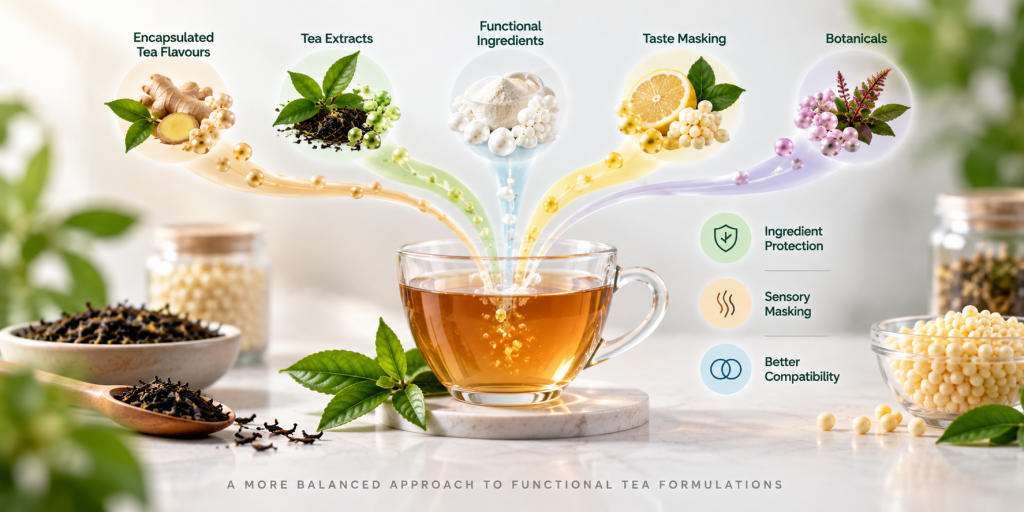
Encapsulation can help reduce direct interaction between certain functional ingredients and the surrounding formulation.
PHS Lifesciences’ 2026 portfolio includes encapsulated functional ingredients such as caffeine, choline bitartrate, L-arginine, L-carnitine, methionine, N-acetyl L-cysteine, alpha-lipoic acid, L-lysine and glutathione. The portfolio identifies enhanced stability, reduced reactivity, controlled and targeted release, masking of unpleasant taste and odour, improved flowability and handling, and compatibility as key benefits of its encapsulated actives.
This becomes particularly relevant when flavour and functionality have to coexist in the same beverage.
Instead of relying entirely on the flavour system to compensate for an unwanted note, the functional ingredient can be considered as part of the encapsulation strategy itself.
The result is a more formulation-oriented approach: protect the sensitive ingredient, manage its interaction with the surrounding system, and then build the sensory profile around the resulting ingredient format.
The Problem: A Flavour Can Be Stable but Still Perform Poorly
Stability alone does not guarantee a successful beverage.
A flavour may remain stable during storage but still fail to distribute uniformly through a formulation. In a powdered tea mix, inconsistent distribution can affect the flavour experience from one serving to another. In a beverage, inadequate dispersion can influence the consistency of the final sensory profile.
This becomes more important during scale-up.
A formulation that performs well in a controlled laboratory trial has to move through blending, filling, processing, packaging and storage at commercial scale. The physical behaviour of the ingredient therefore becomes just as important as its chemical composition.
For formulators, the challenge is not simply keeping the flavour intact. It is making sure the ingredient behaves appropriately throughout the manufacturing process and within the finished product.
The Solution: Engineer the Ingredient for Better Dispersion
Microencapsulation can change the physical form in which a flavour or active ingredient enters a formulation.
For powder-based tea products, an encapsulated ingredient can be evaluated for blending, flowability and uniform distribution. For liquid beverage systems, the encapsulation approach can be considered in relation to dispersion and flavour retention.
PHS identifies uniform dispersion and better retention in RTD and powder applications among the benefits of its encapsulated beverage flavours. The portfolio also highlights better pH stability and premium sensory impact.
This is an important distinction because formulation performance is determined not only by what an ingredient contains, but also by how that ingredient behaves during processing and in the final product matrix.
Different Tea Formats, Different Formulation Requirements
There is no single “tea formulation.”
A tea bag, an instant tea powder, an RTD tea and a functional beverage may all use tea as their foundation, but their ingredient requirements are very different.
A dry format may place greater emphasis on flowability, blending, moisture management and flavour retention. An RTD product introduces liquid dispersion and processing conditions. A functional tea may require several active ingredients to coexist with the flavour system without creating unwanted sensory interactions.
This is why an encapsulated ingredient should not be selected only by looking at its name or flavour profile.
The final application should determine the required ingredient performance.
Where PHS Encapsulation Fits in Tea and Beverage Formulations
PHS Lifesciences’ encapsulation portfolio is relevant across several tea and beverage formats because the technology can be applied to both flavour systems and functional ingredients.
For beverage flavours, the 2026 PHS brochure lists Orange, Lemon, Lime, Bergamot, Strawberry, Ginger, Basil, Honey, Vanilla, Chocolate and Mint in natural and nature-identical encapsulated formats. The stated benefits include better pH stability, uniform dispersion, better retention in RTD and powder applications, premium sensory impact and masking of bitter notes.
Tea Bags and Flavoured Tea
In tea bag applications, flavour needs to remain associated with the dry product until preparation, while delivering the intended sensory profile when the tea is brewed.
Encapsulated flavour formats can be considered where flavour retention and ingredient handling are important. The objective is not simply to add more flavour, but to provide the flavour in a format designed around the way the finished product is stored, handled and consumed.
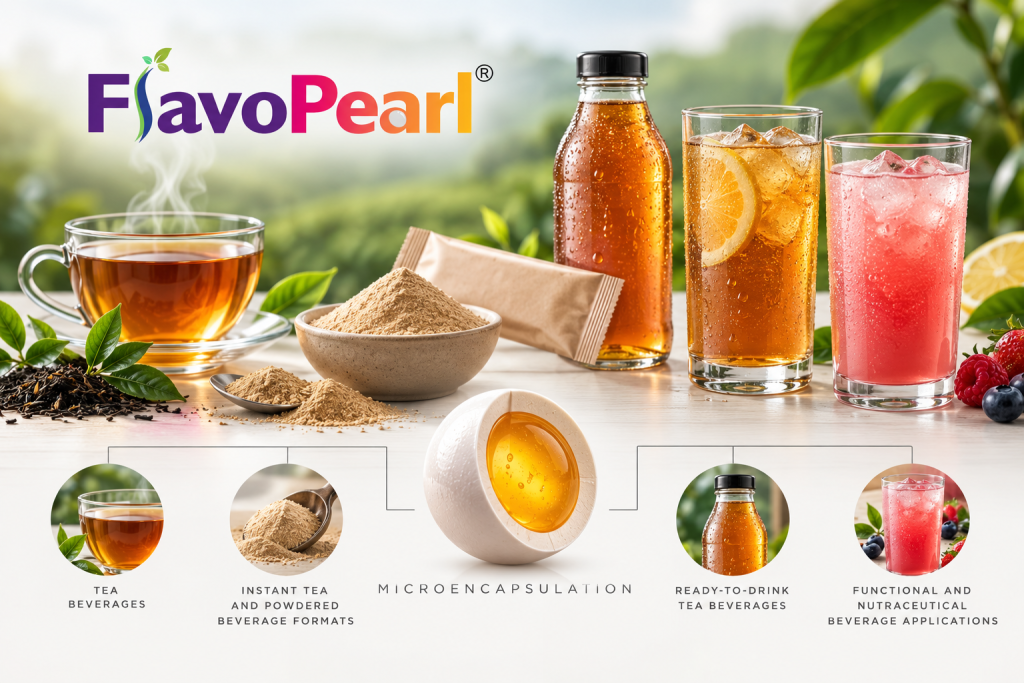
Instant Tea and Powdered Beverage Formats
Instant tea powders and premixes introduce a different set of challenges. The flavour needs to blend consistently with the dry ingredients and remain suitable during storage.
Here, properties such as uniform dispersion, flowability, handling and flavour retention become important formulation considerations. PHS specifically identifies better retention in powder applications and uniform dispersion among the benefits of its encapsulated beverage flavour systems.
Ready-to-Drink Tea Beverages
RTD tea formulations have to deal with the conditions associated with liquid processing and storage. The flavour system needs to remain compatible with the beverage matrix while maintaining the intended sensory profile.
PHS’s beverage encapsulation portfolio specifically identifies better retention in RTD applications and better pH stability as benefits of its encapsulated flavour systems.
Functional Tea and Beverage Formulations
Functional tea formulations create an additional layer of complexity because flavour and active ingredients have to work together.
PHS offers encapsulated functional ingredients including caffeine, choline bitartrate, L-arginine, L-carnitine, methionine, NAC, alpha-lipoic acid, L-lysine and glutathione. Its portfolio is positioned around stability, reduced reactivity, taste and odour masking, controlled or targeted release, flowability and compatibility.
This allows formulators to consider encapsulation not only for the flavour system but also for the functional ingredients that may otherwise create sensory or compatibility challenges.
Nutraceutical Beverage Applications
The application can extend further into beverages containing vitamins and nutraceutical actives.
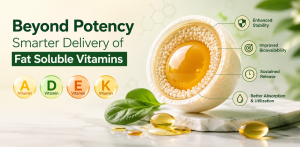
PHS’s Vita-Q® portfolio includes microencapsulated Vitamin K2, Vitamin D2, Vitamin D3, Vitamin A Acetate, DHA, Astaxanthin, MCT Oil, CoQ10, Lutein, Biotin and Resveratrol, among other fat-soluble vitamins and actives. The portfolio identifies benefits including enhanced stability, masking of off-flavours and odours, reduced interaction with other ingredients, improved shelf life and improved handling.
For beverage developers, however, ingredient suitability still needs to be assessed against the specific formulation, processing conditions and final beverage matrix.
Choosing Encapsulation Around the Application
This application-specific approach is important because there is no universal encapsulation solution for every flavour or beverage.
A ginger flavour intended for an instant tea powder may have different requirements from a citrus flavour intended for an RTD beverage. Similarly, a functional beverage containing caffeine and other active ingredients may require a different approach from a conventional flavoured tea.
The formulation team therefore needs to consider the complete product environment: the ingredient itself, processing temperature, pH, moisture exposure, storage conditions, dispersion requirements, interactions with other ingredients and the intended sensory experience.
Encapsulation works best when these factors are considered together.
The question should not simply be “Which encapsulated ingredient do we have?”
It should be: “Which ingredient format is best suited to the performance requirement of this product?”
From Tea Flavour to Flavour Performance
This is where tea innovation becomes more interesting.
The next generation of tea products will not compete only on whether they contain ginger, lemon, cardamom or another recognisable flavour. They will also be judged by how consistently that flavour performs from manufacturing through shelf life and final consumption.
Functional tea products add another dimension. The flavour has to work alongside active ingredients without allowing unwanted taste or odour characteristics to dominate the sensory profile.
Microencapsulation provides formulators with a tool to approach these challenges at the ingredient level.
It allows the development team to think about protection, dispersion, interaction, handling and sensory performance before the ingredient becomes part of the finished formulation.
That is a very different approach from simply adding more flavour at the end of the development process.
Why This Matters on International Tea Day 2026
International Tea Day is a natural moment to celebrate tea, but for the food and beverage industry, it is also an opportunity to look at what is happening behind the cup.
Tea is moving into instant formats, RTD beverages, functional formulations and increasingly sophisticated flavour systems. With that evolution, formulation challenges are becoming more technical.
The flavour has to survive the process. The functional ingredient has to coexist with the flavour. The powder has to blend and disperse. The beverage has to remain consistent. And the final sensory experience has to remain aligned with the product that was originally designed.
These are not separate challenges. They are connected formulation problems. And that is where ingredient technology can make a difference.
PHS Lifesciences: Building Ingredient Performance into the Formulation
At PHS Lifesciences, microencapsulation is applied across flavour systems, functional ingredients and nutraceutical actives.
For the beverage industry, its encapsulated flavour portfolio is designed around requirements such as pH stability, uniform dispersion, retention in RTD and powder formats, sensory impact and masking of bitter notes.
Its encapsulated active portfolio addresses another side of formulation development, with ingredients designed around stability, reduced reactivity, controlled release, taste and odour masking, handling and compatibility.
This makes the discussion broader than simply sourcing a flavour.
It begins with the actual formulation problem.
What is changing during processing? Where is the ingredient interacting with the formulation? Is the challenge stability, dispersion, sensory performance or handling? What does the final product require?
Once those questions are understood, the encapsulation strategy can be evaluated around the application.
That is where encapsulation becomes more than a processing technology.
It becomes a formulation tool.
The Future of Tea Is Not Just About What Goes Into the Cup
Tea has evolved from a traditional brewed beverage into a platform for flavour innovation, convenience and functional product development.
But successful innovation does not stop at adding a new ingredient.
The real challenge is making that ingredient work.
When flavour stability, sensory masking, dispersion, ingredient protection and formulation compatibility become part of the development discussion, microencapsulation gives manufacturers another way to approach product performance.
And perhaps that is the more interesting story behind International Tea Day 2026.
The future of tea is being shaped not only by what goes into the cup, but by the technology that helps those ingredients perform once they get there.
FAQs
What are microencapsulated tea flavours?
Microencapsulated tea flavours are flavour ingredients incorporated within a protective matrix. This format can help support flavour stability, handling, dispersion and retention depending on the flavour, encapsulation system and final application.
Why use encapsulated flavours in instant tea?
Instant tea powders require flavours that can be incorporated uniformly into a dry blend and remain suitable during storage. Encapsulation can support flavour retention, dispersion and handling in powder-based applications.
Can encapsulated flavours be used in RTD tea?
Yes. Encapsulated flavour systems can be evaluated for RTD applications. The appropriate format depends on the flavour chemistry, beverage matrix, pH, processing conditions and storage requirements.
What beverage flavours does PHS Lifesciences offer in encapsulated formats?
The 2026 PHS brochure lists Orange, Lemon, Lime, Bergamot, Strawberry, Ginger, Basil, Honey, Vanilla, Chocolate and Mint in natural and nature-identical encapsulated flavour formats for the beverage industry.
Can functional ingredients also be encapsulated for tea and beverage applications?
Yes. PHS’s encapsulated active portfolio includes ingredients such as caffeine, choline bitartrate, L-arginine, L-carnitine, methionine, NAC, alpha-lipoic acid, L-lysine and glutathione.
Does encapsulation guarantee flavour stability throughout shelf life?
No. Encapsulation is not a universal guarantee of shelf-life stability. Actual performance depends on the flavour chemistry, encapsulation system, formulation, processing, packaging and storage conditions. Finished-product testing remains important when evaluating an encapsulated ingredient.