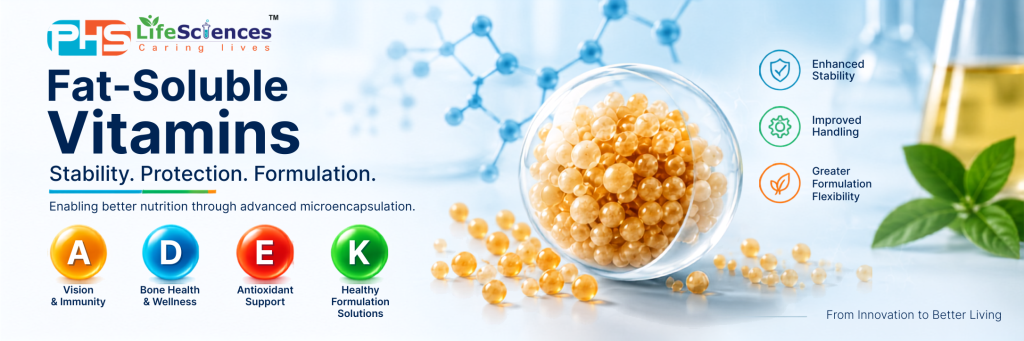
Fat-soluble vitamins such as vitamins A, D, E and K are widely used in nutritional supplements, functional foods and beverages. From a formulation perspective, however, their value is not determined by potency alone. The physical form of the ingredient, its stability during processing and storage, its interaction with other ingredients, and its ability to be incorporated consistently into the final product all matter.
This is where ingredient format and delivery technology become important. Microencapsulation can place a sensitive active within a protective matrix, helping formulators address challenges related to stability, handling, compatibility and product development.
For manufacturers working with fat-soluble vitamins, the objective is therefore not simply to select a vitamin. It is to select a form that is appropriate for the formulation, processing conditions and intended product format.
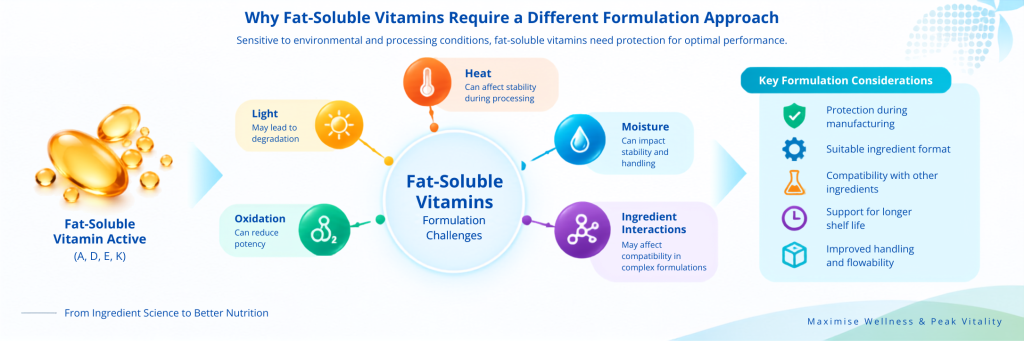
Fat-soluble vitamins are lipophilic compounds, which means their formulation behaviour can differ from that of water-soluble ingredients. Depending on the active and the product system, formulators may need to consider factors such as exposure to light, heat, moisture and oxygen, as well as compatibility with minerals and other ingredients.
These considerations become particularly relevant when a formulation contains several active ingredients. A vitamin may be chemically sensitive, physically difficult to distribute, or affected by the surrounding formulation environment. The final product must also maintain acceptable physical properties during manufacturing, filling, storage and use.
For this reason, ingredient selection should consider more than assay or potency. The required concentration, physical form, processing conditions, target dosage format and storage requirements should all be evaluated.
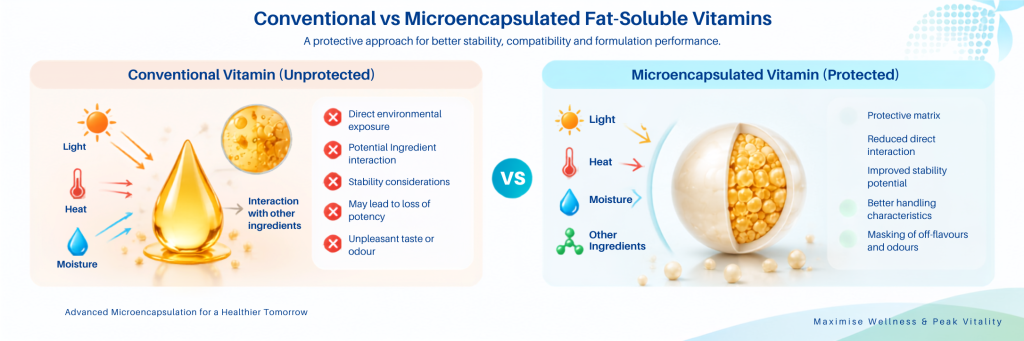
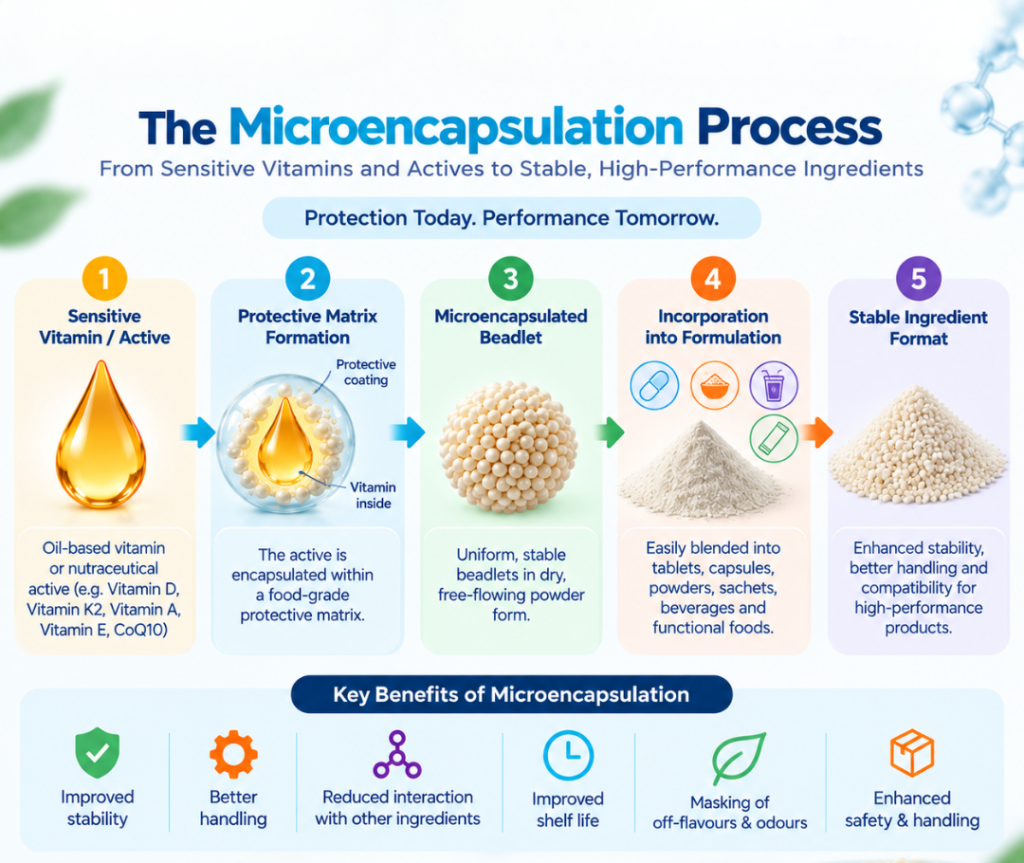
Microencapsulation is a formulation technology in which an active ingredient is surrounded or incorporated within a protective material or matrix. The resulting particles can be designed to provide a more manageable form of the active for incorporation into a finished product.
For sensitive vitamins and nutraceutical actives, the protective matrix can help reduce direct exposure to the surrounding environment. Depending on the active, encapsulation system and application, this may support stability, handling, ingredient compatibility and controlled delivery behaviour.
The exact performance of an encapsulated ingredient depends on the active, coating or matrix system, particle characteristics, concentration and final application. Microencapsulation should therefore be viewed as a formulation tool rather than a universal solution for every product.
Vitamin D is commonly supplied in D2 and D3 forms, but the appropriate format depends on the formulation and product requirements. For manufacturers, the decision may involve active concentration, dietary positioning, physical form, processing conditions and compatibility with the rest of the formula.
PHS Lifesciences offers Vita-Q® Vitamin D formats including Vitamin D2 beadlets in a vegetarian format, Vitamin D3 beadlets in vegetarian and non-vegetarian formats, and Vitamin D3 oil in a vegetarian format. These formats provide formulators with options depending on the intended application.
Microencapsulation can also help address formulation challenges associated with sensitive actives by providing a protective matrix and a more manageable ingredient form.
Vitamin K2 is another active where formulation format and stability can be important. PHS Vita-Q® offers microencapsulated Vitamin K2/7 as powder or beadlets in natural and synthetic MK-7 formats.
The 2026 PHS portfolio includes Natural MK-7 0.1%, Natural MK-7 0.2%, Synthetic MK-7 0.1% and Synthetic MK-7 0.2%, along with natural and synthetic Vitamin K2 oils. Customizable concentrations are also available.
According to the PHS product information, the encapsulation system is designed to protect Vitamin K2 from interactions with minerals and exposure to light, heat and oxidation. The listed formulation benefits include enhanced stability, low hygroscopicity, excellent flowability, reduced interaction and improved shelf life.
Vitamin A ingredients can be sensitive to formulation and storage conditions. For manufacturers, the choice of ingredient form can therefore be an important part of product development.
The PHS portfolio includes Vitamin A Acetate Beadlets. A beadlet format can provide a practical dry ingredient form for formulations where consistent incorporation, handling and protection of the active are important.
As with any encapsulated ingredient, the final formulation should be evaluated under the actual processing and storage conditions of the finished product.
Vitamin E is commonly used as an antioxidant ingredient, but its physical form still matters during product development. The current Vita-Q® portfolio lists Vitamin E acetate beadlets at 50%.
An encapsulated beadlet format can be considered where a dry, manageable ingredient form is preferred. Selection should be based on the required concentration, product matrix, processing conditions and compatibility with other ingredients.
Encapsulation is not limited to vitamins A, D, E and K. The PHS Vita-Q® portfolio also covers selected nutraceutical actives in encapsulated formats.
Depending on the product and application, the portfolio includes ingredients such as DHA, Astaxanthin, MCT Oil, Coenzyme Q10, Lutein, Biotin and Resveratrol. The current online Vita-Q® portfolio also includes selected formats of Folic Acid, Beta-Carotene and Lycopene.
These ingredients have different chemical and physical characteristics, so the same encapsulation approach should not automatically be assumed to deliver identical results across all actives. Each ingredient and application requires its own formulation assessment.
A formulation rarely contains a single active ingredient. Vitamins and nutraceutical actives may be combined with minerals, acids, flavours, excipients, carriers and other functional ingredients.
Interactions within this environment can affect stability, physical properties, sensory characteristics or the way an ingredient behaves during processing. A protective encapsulation matrix can reduce direct contact between the active and its surrounding environment, depending on the system and application.
This is particularly relevant for formulations where several sensitive ingredients must remain stable together through manufacturing and storage.
One of the main reasons formulators consider microencapsulation is protection. By surrounding a sensitive ingredient with a protective matrix, encapsulation can reduce direct exposure to environmental and formulation stressors.
For Vita-Q®, PHS identifies benefits including improved stability, protection against oxidation or degradation, reduced interaction with other ingredients, improved shelf life and improved handling. The actual performance depends on the active and final formulation.
It is important to distinguish between ingredient-level benefits and finished-product performance. An encapsulated ingredient may provide a useful starting point, but finished-product stability still needs to be evaluated under the intended processing and storage conditions.
Formulation performance is not only about chemical stability. Physical handling can also influence manufacturing efficiency and consistency.
Powders and beadlets need to be transferred, weighed, blended and incorporated consistently. PHS specifically identifies low hygroscopicity and excellent flowability as benefits of its microencapsulated Vitamin K2/7 beadlet formats.
For manufacturers, physical properties such as flowability, moisture behaviour, particle characteristics and dispersion should therefore be considered alongside active concentration.
Encapsulated vitamins and nutraceutical actives can be evaluated across different product formats, depending on the ingredient and formulation requirements.
The current PHS Tea & Beverages application portfolio also highlights microencapsulated vitamins and nutraceutical actives for beverage applications, where stability, dispersion and sensory considerations can be important.
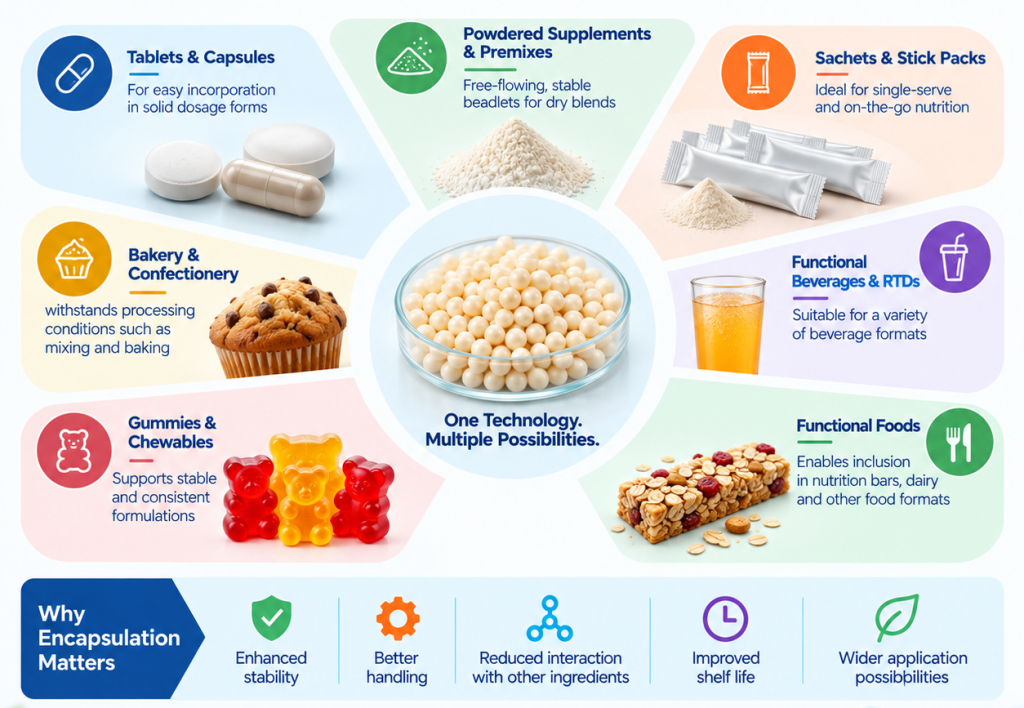
There is no single best format for every formulation. The right choice depends on the active ingredient and the conditions it will experience from manufacturing through storage.
This approach helps formulators select an ingredient format based on the real requirements of the product, rather than selecting an ingredient solely by potency.
Vita-Q® is the PHS Lifesciences microencapsulation platform for fat-soluble vitamins and selected nutraceutical actives. The platform is positioned around stabilization, protection and formulation flexibility.
The 2026 PHS brochure includes a portfolio covering Vitamin K2, Vitamin D2, Vitamin D3, Vitamin A Acetate, DHA, Astaxanthin, MCT Oil, Coenzyme Q10, Lutein, Biotin and Resveratrol in selected beadlet or oil formats. The current online portfolio also lists additional encapsulated actives and concentrations.
The objective is to provide ingredient formats that can be evaluated according to the needs of different nutraceutical, food and beverage formulations.
For formulations that require both Vitamin D3 and Vitamin K2, PHS offers Vita-Q® Duo, a single beadlet solution combining Vitamin D3 and Vitamin K2.
The 2026 brochure specifies a single beadlet providing Vitamin D3 at 600 IU and Vitamin K2 at 55 mcg, available in 10 mg and 20 mg formats. Customizable vegetarian D3 and K2 strengths are also available.
A combined beadlet format can be considered where a formulation requires both actives in a coordinated ingredient format. Final product performance should still be verified in the intended formulation and process.
In nutraceutical formulation, selecting an active is only one part of product development. The delivery format can influence how the ingredient behaves during processing, how easily it can be handled and how well it fits within the final product system.
For fat-soluble vitamins, microencapsulation can provide a practical route for addressing specific formulation requirements. But the technology should always be selected in relation to the active, process and final product.
The most effective formulation strategy is therefore application-led: define the product requirements first, then select the appropriate active format and validate performance under real conditions.
Fat-soluble vitamins A, D, E and K bring important formulation considerations because their behaviour can be affected by environmental conditions, processing and interactions within a complex product matrix.
Microencapsulation offers formulators a way to provide a protective matrix around sensitive actives and can support stability, handling, compatibility and product development when the technology is appropriately matched to the application.
With Vita-Q®, PHS Lifesciences provides microencapsulated vitamin and nutraceutical ingredient formats designed for different formulation requirements, including Vitamin K2, Vitamin D2, Vitamin D3, Vitamin A Acetate and selected additional actives. Vita-Q® Duo further combines Vitamin D3 and K2 in a single beadlet format.
For manufacturers, the key is to evaluate the complete formulation environment—not just the active ingredient—and select an ingredient format that can perform under the intended processing and storage conditions.
What are fat-soluble vitamins?
Fat-soluble vitamins are vitamins that are lipophilic. The main fat-soluble vitamins are A, D, E and K.
Why are fat-soluble vitamins microencapsulated?
Microencapsulation can surround an active with a protective matrix and may help address formulation challenges such as environmental exposure, ingredient interaction, stability and handling.
Does microencapsulation guarantee finished-product stability?
No. Encapsulation can support ingredient stability, but the finished product must still be evaluated under its actual processing, packaging and storage conditions.
What formats does PHS offer for Vitamin D and Vitamin K2?
The PHS portfolio includes Vitamin D2 beadlets, Vitamin D3 beadlets, Vitamin D3 oil, and Vitamin K2/7 beadlets or powder as well as natural and synthetic Vitamin K2 oils. Specific concentrations and formats depend on the product.
How should formulators select an encapsulated vitamin?
Selection should consider the active, concentration, dosage form, processing conditions, ingredient compatibility, physical handling requirements, storage conditions and required shelf life.
If you are developing a supplement, functional food or beverage containing sensitive vitamins or nutraceutical actives, the right ingredient format can make a significant difference to formulation development.
Explore Vita-Q® microencapsulated vitamins and nutraceutical actives from PHS Lifesciences and discuss your specific formulation requirements with the technical team.
+91-7777053672
Plot No 47, Survey No 156/2, Shri Guru Gajanan Industrial Estate, Vihloli-Ambad Link Road, Vihloli, Pathardi Shivar, Vilholi, Maharashtra 422010
+1-224-788-0609
© 2025 All rights reserved by PHS Lifesciences.
