Imagine developing a nutritional supplement with excellent functional ingredients, only to discover that its strong smell and unpleasant taste make it difficult for consumers to enjoy.
This is one of the common challenges associated with N-Acetyl-L-Cysteine (NAC).
NAC is widely used in nutraceutical and sports nutrition formulations because of its role as a precursor to glutathione, an important antioxidant in the human body. However, working with conventional NAC is not always straightforward. Its characteristic sulfurous odour, acidic taste, moisture sensitivity and oxidation concerns can make product development challenging.
For manufacturers, these issues go beyond the sensory experience. They can also affect powder handling, processing, storage and the development of different supplement formats.
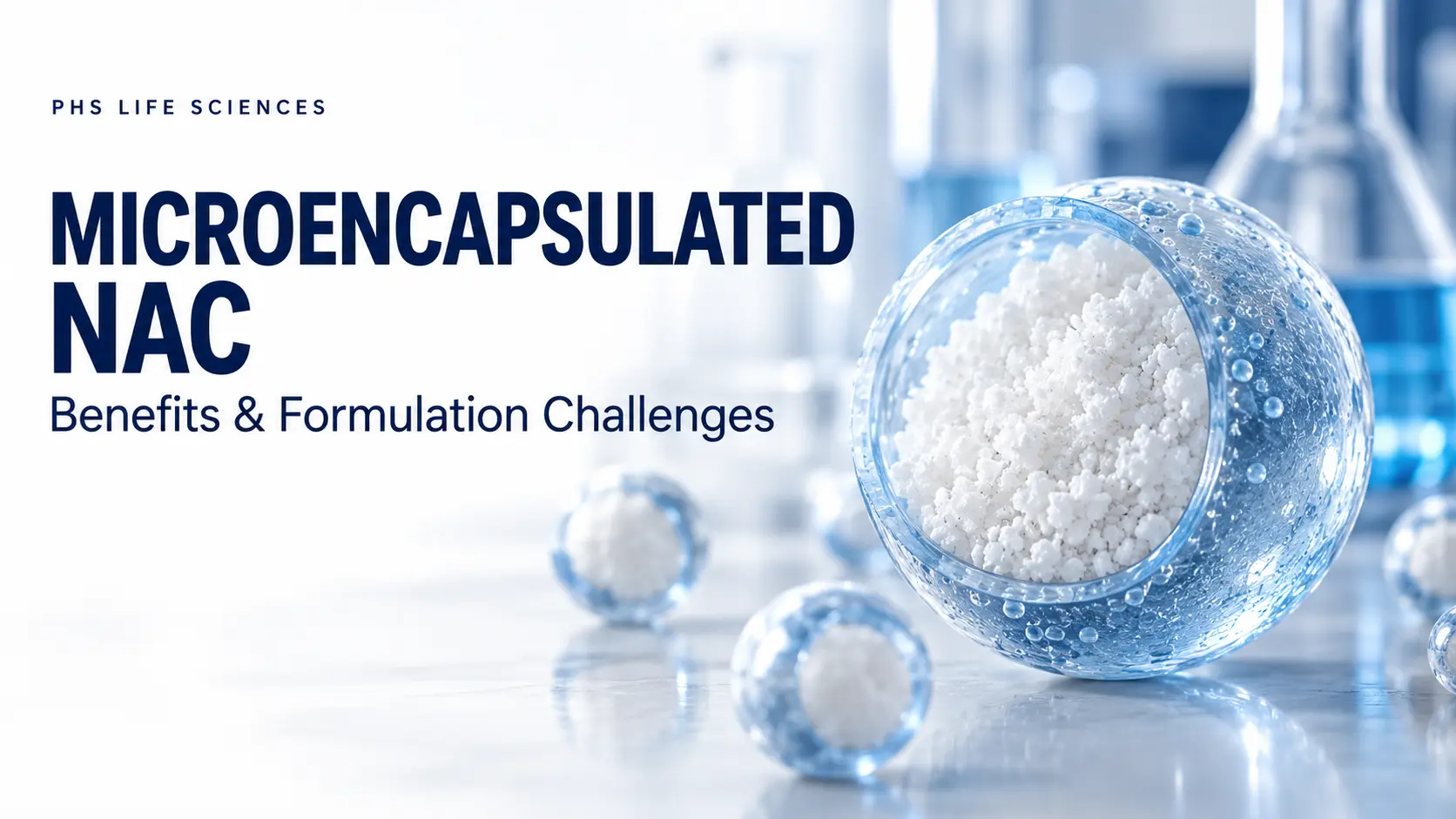
This is where microencapsulation technology offers a practical formulation solution.
With its UniQ-Coat® technology, PHS Life Sciences brings a microencapsulated NAC ingredient designed to address these challenges and provide greater flexibility in nutraceutical product development.
Let’s explore why conventional NAC can be difficult to formulate and how microencapsulation can make a difference.
What Is NAC and Why Is It Used in Nutraceutical Formulations?
N-Acetyl-L-Cysteine (NAC) is a derivative of the amino acid L-cysteine. One of its key functions is supporting the body’s production of glutathione (GSH), a naturally occurring antioxidant that plays an important role in cellular protection.
Glutathione contributes to several essential processes, including:
- Supporting the body’s antioxidant defence system.
- Maintaining cellular redox balance.
- Helping protect cells against oxidative damage.
- Supporting normal cellular functions.
Because of these properties, NAC is used in various dietary supplements and sports nutrition formulations.
However, an ingredient’s functional value is only one part of product development. Its taste, smell, stability and processing characteristics also matter.
And conventional NAC presents some interesting challenges.
Why Is Conventional NAC Difficult to Formulate?
For nutraceutical manufacturers, incorporating NAC into a finished product requires more than simply adding the ingredient to a formulation.
Its natural physical and chemical characteristics can create difficulties at different stages of product development.
1. Strong Sulfurous Odour
The first thing many manufacturers notice about conventional NAC is its distinctive smell.
It has a strong sulfurous odour, often described as similar to rotten eggs. This unpleasant smell can become noticeable during raw material handling, blending and product storage.
For products such as nutritional powders, chewables and flavoured supplements, this creates a significant sensory challenge.
Even when the overall formulation is well designed, an unpleasant aroma can affect the consumer’s experience.
2. Strong Acidic and Sour Taste
Taste is another major concern.
Conventional NAC has an intensely sour and acidic taste, which can be difficult to mask using ordinary flavouring systems.
This becomes particularly challenging when developing:
- Flavoured nutritional powders.
- Chewable supplements.
- Gummies.
- Effervescent products.
- Ready-to-mix nutritional formulations.
Manufacturers may need additional flavouring and masking strategies to achieve an acceptable taste profile.
3. Moisture Sensitivity and Powder Handling
Have you ever worked with a powder that starts flowing well during processing but gradually forms lumps during storage?
Moisture sensitivity can create exactly this type of problem.
Conventional NAC can absorb moisture from its surroundings. This may lead to caking, clumping and reduced powder flowability.
For manufacturers, poor powder handling can affect:
- Blending consistency.
- Filling operations.
- Processing efficiency.
- Storage conditions.
- Overall product quality.
Maintaining suitable environmental and packaging conditions becomes essential.
4. Oxidative Degradation
NAC is also susceptible to oxidation under certain environmental conditions.
Exposure to oxygen and moisture can contribute to the formation of oxidation-related degradation products, including N,N’-diacetylcystine.
This can affect the quality and active ingredient content of the material over time.
For manufacturers, maintaining ingredient stability throughout processing and storage is an important part of product development.
5. Limited Formulation Flexibility
The combination of strong odour, acidic taste and moisture sensitivity can make conventional NAC difficult to incorporate into certain consumer-friendly product formats.
This is particularly relevant for brands looking to develop innovative supplement products with better taste, texture and convenience.
A formulation technology that can address these challenges can open up new possibilities.
How Does Microencapsulation Technology Help?
Microencapsulation is a technology in which an active ingredient is surrounded by a protective coating or matrix.
Think of it as creating a protective layer around an ingredient.
This layer helps control how the active ingredient interacts with its external environment. Depending on the coating system, it can also influence the ingredient’s taste, odour, stability and release behaviour.
In nutraceutical applications, microencapsulation is used to address several formulation challenges.
Key Benefits of Microencapsulation
Taste masking: The protective coating helps reduce direct contact between the active ingredient and taste receptors, improving the overall taste experience.
Odour control: Microencapsulation helps minimise the release of unpleasant odours, making ingredients easier to incorporate into consumer-friendly formulations.
Improved powder handling: An appropriately designed coating can improve powder flow characteristics and help reduce moisture-related handling issues.
Ingredient protection: The coating acts as a barrier against external environmental conditions, helping protect sensitive ingredients.
Controlled release: Microencapsulation can modify the release behaviour of an ingredient under different environmental conditions, including changes in pH.
For ingredients such as NAC, these advantages can make a meaningful difference during formulation development.
UniQ-Coat® NAC: Making NAC Formulation More Convenient
Developing a nutraceutical product involves balancing ingredient functionality with manufacturing requirements and consumer expectations.
PHS Life Sciences’ UniQ-Coat® NAC is a microencapsulated NAC ingredient developed to address some of the key formulation challenges associated with conventional NAC.
By combining microencapsulation with a specialised coating approach, it offers improved sensory and physical characteristics along with a differentiated release profile.
Its key characteristics include:
- Neutral to completely odourless profile.
- Clean, bland and neutral taste.
- Free-flowing, non-hygroscopic powder characteristics.
- Improved protection against oxidative degradation.
- Modified release under different pH conditions.
- Greater flexibility for nutraceutical formulation development.
The objective is simple: make NAC easier to work with while supporting the development of different product formats.
UniQ-Coat® NAC vs. Conventional NAC: What’s the Difference?
Not all NAC ingredients behave the same way during formulation.
The coating technology used in microencapsulated NAC can significantly influence its sensory characteristics, physical properties and release behaviour.
Here is how UniQ-Coat® NAC compares with conventional, uncoated NAC.
| Parameters | UniQ-Coat® NAC | Conventional / Uncoated NAC |
|---|---|---|
| Aroma & Odour Profile | Neutral to completely odourless | Pungent, sulfurous / rotten egg-like aroma |
| Taste Profile | Clean, bland or neutral; easy to flavour in complex formulations | Highly acidic, sour, bitter and tongue-irritating |
| Hygroscopicity & Flow | Free-flowing, non-hygroscopic powder | Cakes and clumps upon exposure to air; poor powder flowability |
| Oxidative Degradation | Improved oxidative protection and active ingredient stability | Susceptible to oxidation and conversion into N,N’-diacetylcystine |
| Formulation Versatility | Suitable for stick packs, chewables, gummies, powders and effervescent formulations | Sensory and handling challenges can restrict certain applications |
| GI & Mucosal Tolerance | Designed to limit gastric-phase release through its protective coating | Rapid dissolution under acidic conditions may contribute to local irritation |
What does this mean for product developers?
The difference is not just about masking an unpleasant smell or taste.
It is about creating an ingredient that is easier to handle, more adaptable to different formulations and designed to provide a specific release profile.
Understanding the Release Behaviour: Gastric vs. Intestinal Conditions
One of the most interesting aspects of microencapsulation is its ability to influence when an ingredient is released.
After consumption, a formulation passes through different gastrointestinal environments. The stomach has highly acidic conditions, while the intestinal environment has a higher pH.
A coating system can be designed to respond differently to these conditions.
The comparative in-vitro dissolution performance of UniQ-Coat® NAC demonstrates this difference.
1. Release in Gastric Fluid (pH 1.2)
The stomach provides a highly acidic environment.
Under simulated gastric conditions:
- UniQ-Coat® NAC: Less than 5% release over 2 hours.
- Conventional NAC: More than 85% dissolved within 15 minutes.
The limited release of microencapsulated NAC indicates that its coating provides resistance under the tested acidic conditions.
This can be useful when developing formulations designed to minimise ingredient release during the gastric phase.
2. Release in Intestinal Fluid (pH 6.8)
As the formulation moves from the stomach to the intestine, the surrounding pH changes.
Under simulated intestinal conditions:
- UniQ-Coat® NAC: Rapid and complete release within approximately 30–45 minutes after gastric transit.
- Conventional NAC: Complete dissolution upon transition to intestinal test conditions.
This demonstrates how the coating system influences the release behaviour of NAC across different pH environments.
Comparative Dissolution Performance
| Parameters | UniQ-Coat® NAC | Conventional NAC |
|---|---|---|
| Gastric Fluid (pH 1.2) Release | Less than 5% released over 2 hours | More than 85% dissolved within 15 minutes |
| Intestinal Fluid (pH 6.8) Release | Rapid, complete release within 30–45 minutes after gastric transit | Complete dissolution upon transition to intestinal conditions |
Why does this matter?
For product developers, release characteristics are an important part of formulation design.
Understanding how an ingredient behaves under different pH conditions can help manufacturers select suitable technologies for their intended product applications.
These dissolution results describe in-vitro performance. They should not be interpreted as direct evidence of improved absorption, bioavailability or clinical efficacy.
Where Can UniQ-Coat® NAC Be Used?
Today’s nutraceutical market offers several product formats beyond traditional tablets and capsules.
Consumers increasingly look for convenient, easy-to-consume products. This makes taste, odour and ingredient compatibility important considerations during development.
Microencapsulated NAC can be explored in several applications.
1. Stick Packs and Powder Supplements
Stick packs are widely used for convenient, single-serving nutritional supplements. However, conventional NAC’s strong odour and acidic taste can affect the finished product. A microencapsulated format can help address these challenges while supporting improved powder handling.
2. Chewable Supplements
Chewable supplements need a pleasant taste and mouthfeel. Since conventional NAC has an intensely sour taste, incorporating it into chewable products can be challenging. Taste-masked NAC offers an alternative for developing more consumer-friendly chewable formulations.
3. Gummies
Gummies have become an attractive format for nutraceutical brands looking to offer convenient and enjoyable supplements. However, ingredient selection is critical. Strong flavours and unpleasant odours can affect the final product. Microencapsulated NAC can be explored in gummy formulations, subject to compatibility and processing evaluations.
4. Nutritional Powders
Powder-based supplements require good flowability, blending characteristics and moisture management. The physical characteristics of microencapsulated NAC can support its incorporation into different nutritional powder formulations.
5. Effervescent Products
Effervescent formulations require careful control of moisture and ingredient compatibility. The protective coating approach offered by microencapsulation can provide an additional formulation option when developing NAC-based effervescent products.
Compatibility and stability should always be evaluated under the intended processing and storage conditions.
Why Is Microencapsulation Important for Nutraceutical Manufacturers?
Choosing the right ingredient is a critical decision in product development.
Manufacturers need to consider more than the active ingredient itself. They also need to evaluate how it performs during processing, how it behaves in the finished formulation and how it maintains quality during storage.
Better sensory experience: Helps address the strong odour and acidic taste of conventional NAC.
Improved powder handling: Supports better flow characteristics and reduced moisture-related handling challenges.
Enhanced ingredient protection: The coating helps reduce exposure to environmental factors that can affect ingredient quality.
Greater product development flexibility: Allows manufacturers to explore different supplement formats.
Modified release characteristics: Provides a differentiated release profile under simulated gastric and intestinal conditions.
For nutraceutical and sports nutrition brands, these characteristics can help simplify some of the challenges involved in developing NAC-based products.
Frequently Asked Questions About Microencapsulated NAC
1. What is microencapsulated NAC?
Microencapsulated NAC is N-Acetyl-L-Cysteine surrounded by a protective coating or matrix. This technology helps modify its sensory properties, environmental exposure and release characteristics.
2. Why does conventional NAC have a strong smell?
NAC contains sulfur, which contributes to its characteristic sulfurous odour. This smell can create challenges during ingredient handling, storage and finished-product development.
3. Does microencapsulation help mask NAC’s taste?
Yes. The protective coating helps reduce direct contact between NAC and taste receptors, which can minimise its unpleasant acidic and sour taste.
4. Does microencapsulated NAC absorb moisture?
The coating can help reduce moisture exposure. UniQ-Coat® NAC is designed as a free-flowing, non-hygroscopic powder, making it suitable for applications where powder handling is an important consideration.
5. How does microencapsulated NAC behave in the stomach?
Under simulated gastric conditions at pH 1.2, UniQ-Coat® NAC demonstrates less than 5% release over 2 hours.
6. Does NAC get released in the intestine?
Yes. Under simulated intestinal conditions at pH 6.8, UniQ-Coat® NAC demonstrates rapid and complete release within approximately 30–45 minutes after gastric transit.
7. Can microencapsulated NAC be used in gummies and powders?
Yes. It can be explored in gummies, nutritional powders, stick packs, chewables and other supplement formats, depending on formulation compatibility and processing conditions.
8. What is the main advantage of microencapsulated NAC over conventional NAC?
Its main advantage is improved formulation flexibility. It is designed to address conventional NAC’s sensory, powder handling and environmental stability challenges while offering a differentiated release profile.
Final Thoughts: Better Formulation Starts with Better Ingredient Technology
NAC has valuable applications in nutraceutical and sports nutrition products. However, its strong odour, acidic taste, moisture sensitivity and oxidation concerns can make conventional NAC difficult to formulate.
Microencapsulation offers a practical way to address these challenges.
With UniQ-Coat® NAC, PHS Life Sciences brings an ingredient technology designed to improve sensory characteristics, powder handling and release behaviour.
For manufacturers looking to develop innovative nutraceutical products, the right encapsulation approach can make ingredient selection and formulation development more flexible.
Looking for a better way to formulate NAC-based products?
Connect with PHS Life Sciences to explore UniQ-Coat® technology and discuss your nutraceutical formulation requirements.
Contact PHS Life Sciences: https://phslifesciences.com/
Further Reading
For research on NAC coating approaches, read Solid phase wax coating of N-acetylcysteine (NAC) to decrease its solubility profileas a ready to mix supplement. This study explores a specific coating system and does not validate UniQ-Coat® NAC performance.