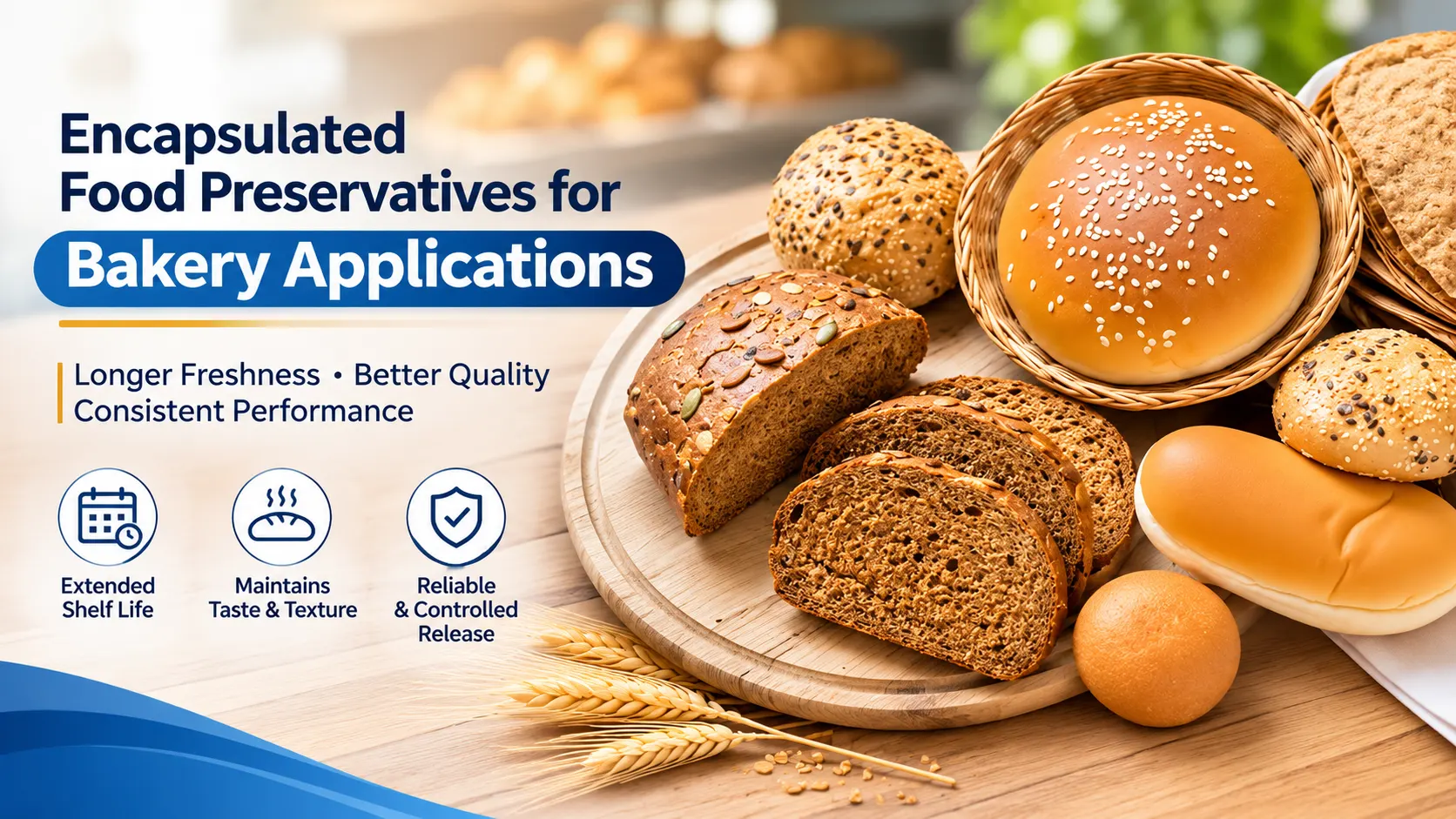
Developing bakery products that maintain their intended quality throughout manufacturing, packaging and storage requires careful ingredient selection. From bread and buns to cakes, tortillas and pizza bases, each product has different formulation requirements.
Selecting the right encapsulated food preservatives for bakery applications can help manufacturers manage ingredient interactions and release timing during different stages of production.
Preservatives, food acids and leavening agents all serve different purposes in bakery manufacturing. However, their interactions with other ingredients can influence how a formulation behaves during processing. This makes ingredient compatibility and release timing important considerations for food manufacturers.
Encapsulated food preservatives offer an approach to managing these interactions. Through microencapsulation, selected ingredients are enclosed within protective coatings that help separate them from the surrounding formulation until the intended release stage.
Understanding the role of individual ingredients and how encapsulation works can help bakery manufacturers make more informed formulation decisions.
Understanding Different Ingredients Used in Bakery Formulations
Bakery formulations involve several ingredient categories, each contributing to a particular function. Preservatives, acidulants and leavening agents should be selected according to their intended purpose rather than treated as interchangeable ingredients.
Food Preservatives
Preservatives are used to help control microbial spoilage in suitable food products.
In bakery manufacturing, mould development is one of the considerations when selecting a preservation system. The choice of preservative depends on the product formulation, processing conditions, packaging and intended storage environment.
Two preservative ingredients commonly associated with bakery applications are sorbic acid and calcium propionate.
Food Acidulants
Acidulants are used to influence acidity and other formulation characteristics. Depending on the ingredient and application, they can contribute to flavour balance and processing requirements.
Citric acid, fumaric acid and malic acid are examples of acidulants that can be considered in selected bakery and dough-based applications.
Leavening Ingredients
Leavening agents contribute to gas production and dough expansion, helping develop the desired volume and texture in baked products.
Managing the timing of leavening reactions can be relevant when developing specific bakery formulations.
These ingredient categories perform different functions. Their selection should be based on the requirements of the finished product and manufacturing process.
What Are Encapsulated Food Preservatives?
Encapsulated food preservatives are particularly relevant for bakery manufacturers looking to manage preservative availability and ingredient compatibility during processing.
Encapsulated food preservatives are active preservative ingredients enclosed within a protective coating or matrix.
The coating acts as a barrier between the active ingredient and the surrounding formulation during selected stages of processing. Depending on the encapsulation system, it can influence when the ingredient becomes available.
In bakery applications, this approach is particularly relevant when certain ingredients need to remain separated from other formulation components during mixing and proofing.
For example, in yeast-based dough systems, premature interactions involving acidic ingredients may affect the processing environment. Encapsulation provides an additional way to manage these interactions.
The technology can also be applied to selected acidulants and leavening ingredients where release timing is an important formulation consideration.
How Does Microencapsulation Work in Bakery Processing?
Using encapsulated food preservatives in selected bakery formulations provides an additional approach to managing ingredient interactions during mixing, proofing and baking.
Ingredient functionality is closely connected to the manufacturing process. In yeast-leavened bakery products, mixing, proofing and baking are three important stages.
A coating designed for bakery applications can help manage ingredient availability across these stages.
1. Mixing: Protecting Ingredients During Dough Preparation
During mixing and kneading, the protective coating remains intact.
This helps keep selected acids and preservatives separated from the surrounding dough system.
For manufacturers, this is relevant when managing ingredient interactions during initial dough preparation.
2. Proofing: Maintaining Ingredient Separation
Proofing allows yeast to contribute to dough expansion and structure development.
During this stage, the encapsulated ingredient remains protected within its coating. This helps avoid premature exposure of selected acidic ingredients to the yeast and supports dough pH development as intended.
Ingredient compatibility is particularly important when developing bread and bun formulations.
3. Baking: Releasing the Active Ingredient
During baking, oven heat melts the coating and releases the active ingredient into the crumb.
The ingredient therefore becomes available at a later stage of the manufacturing process.
This release sequence connects the encapsulation system with the practical requirements of bakery production.
The actual behaviour of an encapsulated ingredient depends on its specifications, the formulation and the processing conditions.
Key Encapsulated Ingredients for Bakery Applications
Selecting an ingredient requires understanding its individual function and suitability for the intended food application.
Encapsulated Sorbic Acid
Sorbic acid is a preservative used in food applications where mould control is required.
In bakery formulations, it can be considered as part of a preservation system for suitable products.
Its encapsulated form provides an additional approach to managing ingredient interactions during processing.
Encapsulated Calcium Propionate
Calcium propionate is another preservative used in bakery applications.
It is relevant when manufacturers are developing products that require an appropriate microbial preservation strategy.
Encapsulated calcium propionate can be evaluated according to the product formulation and intended processing conditions.
Encapsulated Fumaric Acid
Fumaric acid is an acidulant used in food formulations.
Its encapsulated form can be considered when manufacturers want to manage acid availability and ingredient interactions during processing.
Encapsulated Malic Acid
Malic acid is a food acidulant that contributes acidity to formulations.
In bakery-related applications, its selection depends on the intended product characteristics and ingredient compatibility requirements.
Encapsulated Citric Acid
Citric acid is widely used in food manufacturing as an acidulant.
Its encapsulated form provides an additional ingredient option for formulations where managing acid release and interactions is relevant.
The suitability of each ingredient should be determined according to its intended function, formulation and applicable food regulations.
Applications Across Different Bakery Products
The ingredient requirements of bakery products vary according to their composition and manufacturing processes.
Bread and Buns
Bread and buns are yeast-leavened products. Their development involves dough mixing, fermentation, proofing and baking.
Ingredient compatibility is particularly relevant in these products because yeast activity contributes to dough expansion and finished-product structure.
Encapsulated ingredients can be evaluated where managing the timing of preservative and acid interactions is a formulation requirement.
Cakes and Muffins
Cakes and muffins have different formulation characteristics from yeast-raised bread.
Their ingredient requirements depend on the leavening system, moisture conditions, flavour profile and finished-product specifications.
When evaluating encapsulated ingredients, manufacturers should consider how the selected ingredient fits into the overall formulation.
Tortillas
Tortilla production involves dough preparation, resting, sheeting and baking.
Ingredient selection can influence the formulation characteristics required for the finished product.
Encapsulated citric acid, malic acid and fumaric acid are relevant ingredient options for evaluating corn and flour tortilla applications.
Pizza Bases
Pizza bases have different formulation and storage requirements depending on their intended format.
Manufacturers may need to consider dough characteristics, ingredient interactions, processing temperatures and distribution conditions.
Encapsulated ingredients can be evaluated according to the requirements of the specific pizza base formulation.
How to Select the Right Encapsulated Ingredient for Bakery Manufacturing
Choosing an encapsulated ingredient should begin with the functional requirement of the product.
The following considerations can help guide the selection process.
1. Identify the ingredient function
Determine whether the formulation requires a preservative, acidulant or leavening ingredient.
2. Understand the product formulation
Review the flour, water, yeast, fats, sugars and other ingredients used in the recipe.
3. Evaluate processing conditions
Consider mixing time, kneading, proofing, baking temperatures and other manufacturing parameters.
4. Assess ingredient compatibility
Understand how the selected ingredient interacts with yeast, gluten and other formulation components.
5. Define finished-product requirements
Consider the intended texture, flavour, appearance, packaging and storage conditions.
6. Conduct application trials
Evaluate the encapsulated ingredient in the actual formulation under representative processing conditions.
7. Verify regulatory suitability
Check permitted food-additive uses, maximum levels and labelling requirements in the intended market.
A structured evaluation helps manufacturers determine whether an encapsulated ingredient is appropriate for their product and production process.
Exploring Microencapsulation for Bakery Formulations
Ingredient protection and release management are increasingly relevant considerations in food formulation.
UniQ-Coat® by PHS Life Sciences is a microencapsulation technology for selected food acids, preservatives, leavening agents and salt.
The technology is relevant to bakery and dough-based applications where ingredient interactions and release timing need to be considered.
Its ingredient applications include:
- Sorbic acid and calcium propionate for preservative applications.
- Fumaric acid, malic acid and citric acid for acidulant applications.
- Selected leavening ingredients for dough-based formulations.
- Encapsulated salt for specific food applications.
The suitability of an ingredient depends on its intended function, formulation requirements and processing conditions.
For bakery manufacturers and food technologists, understanding these differences is an important part of selecting an appropriate ingredient system.
Frequently Asked Questions
1. What are encapsulated food preservatives used for in bakery products?
Encapsulated food preservatives are used in suitable formulations where ingredient protection and release timing are relevant. They can help manage interactions between selected preservatives and other formulation components during processing.
2. Which preservatives are commonly considered for bakery applications?
Sorbic acid and calcium propionate are preservative ingredients used in suitable bakery applications. Their selection depends on the formulation, intended preservation function and regulatory requirements.
3. What is the difference between preservatives and acidulants?
Preservatives are used to help control microbial spoilage, while acidulants influence acidity and related formulation characteristics. Sorbic acid and calcium propionate are preservatives, whereas citric acid, fumaric acid and malic acid are acidulants.
4. How does microencapsulation help in yeast-based bakery formulations?
Microencapsulation helps separate selected ingredients from the dough system during mixing and proofing. This can help manage premature interactions with yeast and other dough components.
5. Which bakery products can use encapsulated ingredients?
Encapsulated ingredients can be evaluated for bread, buns, cakes, muffins, tortillas and pizza bases. Ingredient suitability depends on the formulation and manufacturing process.
6. What happens to encapsulated ingredients during baking?
In the UniQ-Coat® bakery release process, oven heat melts the coating and releases the active ingredient into the crumb.
7. How can manufacturers determine whether an encapsulated ingredient is suitable?
Manufacturers should assess ingredient functionality, formulation compatibility, processing conditions, finished-product requirements and regulatory suitability. Application trials are necessary before commercial use.
Conclusion
Bakery ingredient selection involves understanding the function of each ingredient and how it behaves within the manufacturing process.
Preservatives such as sorbic acid and calcium propionate serve a different purpose from acidulants such as citric acid, fumaric acid and malic acid. Managing their interactions and release timing can be an important consideration in selected bakery formulations.
Microencapsulation provides an additional approach to ingredient protection and release management, particularly in dough-based applications where mixing, proofing and baking influence ingredient behaviour.
Through UniQ-Coat®, PHS Life Sciences offers microencapsulated food ingredients for bakery, tortilla and pizza applications.
For manufacturers developing bakery products, selecting an appropriate ingredient begins with understanding the formulation, processing requirements and intended product characteristics.
Discuss Your Bakery Formulation Requirements
Developing a bakery formulation that meets specific processing and product requirements?
Connect with PHS Life Sciences to discuss encapsulated preservatives, food acidulants and other ingredient requirements for your application.
Explore UniQ-Coat® microencapsulation technology and discuss your formulation requirements with the PHS team.
Contact PHS Life Sciences
Website: https://phslifesciences.com/
Email: marketing@phslifesciences.com
Phone: +91 77770 53672
External Research Reference
For additional scientific background on encapsulation technology in bakery and cereal-based products, refer to the following research publication:
Rousta et al. (2021) –
Use of encapsulation technology to enrich and fortify bakery, pasta, and cereal-based products,
Trends in Food Science & Technology.
Read the Research Paper on ScienceDirect