
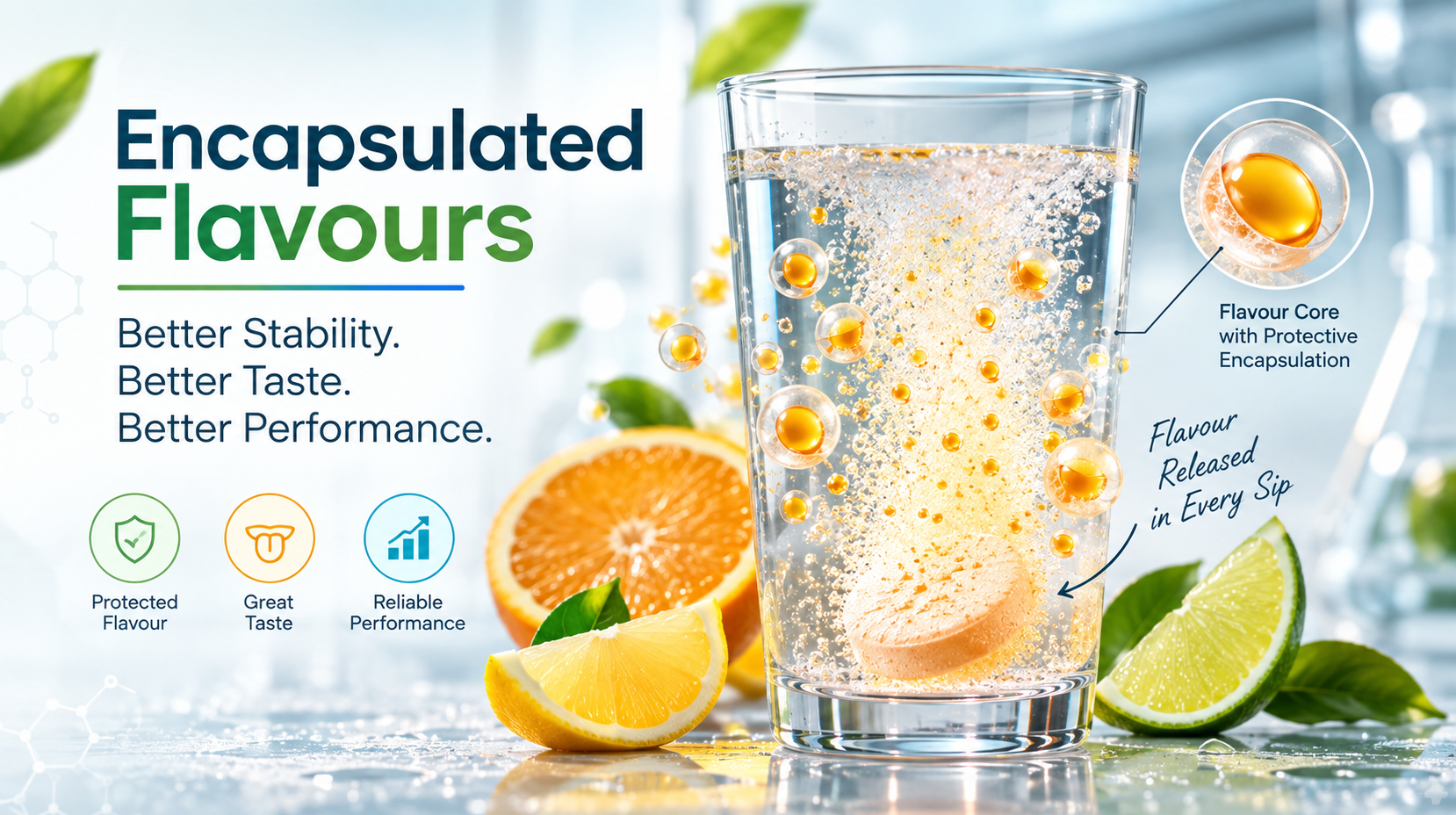
Discover how FlavoPearl® encapsulated flavours improve stability, taste masking, and sensory consistency in effervescent tablets, ORS, and nutraceutical sachets.
Effervescent products, oral rehydration solutions (ORS), electrolyte powders and nutraceutical sachets are designed to offer convenient and easy-to-consume formats. Consumers expect these products to dissolve effectively, deliver a pleasant taste and provide a consistent sensory experience from the first serving to the last.
For formulators, achieving this balance is not always straightforward. These formulations often contain electrolytes, acids, minerals and other functional ingredients that can create significant sensory and stability challenges. Flavours may lose intensity during storage, interact with other ingredients or become difficult to distribute consistently throughout a dry blend.
This is where encapsulated flavours for effervescent products can offer an important formulation advantage. These flavour systems can also be relevant for ORS, electrolyte powders and nutraceutical sachets, where maintaining sensory quality throughout processing and storage is a key consideration.
By protecting sensitive flavour compounds within an encapsulating matrix, microencapsulation can help support flavour stability, handling characteristics and sensory consistency in challenging dry applications. The actual performance, however, depends on the complete formulation, processing conditions, packaging and storage environment.
At PHS Lifesciences, FlavoPearl® encapsulated flavours are developed for relevant food, beverage and nutraceutical applications where flavour performance, stability and application suitability need to be evaluated as part of the overall formulation.
Dry nutritional and hydration products can bring together ingredients with significantly different physical and sensory properties. A single formulation may contain mineral salts, electrolytes, acids, bicarbonates, sweeteners, vitamins and flavouring ingredients, all of which must remain stable and perform as intended until the product is consumed.
The sensory challenge is particularly significant.
Electrolytes and minerals can contribute salty, metallic or bitter notes. Nutraceutical ingredients may have strong inherent flavours that are difficult to balance. Simply increasing the amount of flavour is not always an effective solution, as excessive flavouring can create an unbalanced sensory profile and may introduce additional formulation considerations.
Storage conditions also matter. Many flavour compounds contain volatile components that can be affected by exposure to heat, oxygen, moisture and light. Over time, these factors may influence aroma intensity and the overall flavour profile of the finished product.
Effervescent formulations require particular attention because moisture control is critical. Premature interaction between acidic and alkaline components can compromise product performance. While flavour encapsulation is not a replacement for proper formulation controls or suitable packaging, a well-selected encapsulated flavour system can complement the overall approach to ingredient stability.
Another important consideration is distribution within a dry blend. Differences in particle size, density and physical characteristics can affect how ingredients behave during blending, transportation and filling. If flavour components are not distributed consistently, consumers may experience variation from one serving to another.
For these reasons, flavour development in powdered and effervescent products requires more than selecting an appealing flavour profile. It requires an understanding of how the flavour system interacts with the complete product matrix.
Effervescent products, oral rehydration solutions (ORS), electrolyte powders and nutraceutical sachets are designed to offer convenient and easy-to-consume formats. Consumers expect these products to dissolve effectively, deliver a pleasant taste and provide a consistent sensory experience from the first serving to the last.
For formulators, achieving this balance is not always straightforward. These formulations often contain electrolytes, acids, minerals and other functional ingredients that can create significant sensory and stability challenges. Flavours may lose intensity during storage, interact with other ingredients or become difficult to distribute consistently throughout a dry blend.
This is where encapsulated flavours for effervescent products can offer an important formulation advantage. These flavour systems can also be relevant for ORS, electrolyte powders and nutraceutical sachets, where maintaining sensory quality throughout processing and storage is a key consideration.
By protecting sensitive flavour compounds within an encapsulating matrix, microencapsulation can help support flavour stability, handling characteristics and sensory consistency in challenging dry applications. The actual performance, however, depends on the complete formulation, processing conditions, packaging and storage environment.
At PHS Lifesciences, FlavoPearl® encapsulated flavours are developed for relevant food, beverage and nutraceutical applications where flavour performance, stability and application suitability need to be evaluated as part of the overall formulation.
Encapsulated flavours, often referred to as microencapsulated flavours, are flavour compounds that are incorporated within a protective material or encapsulating matrix.
The encapsulating structure separates the flavour from the surrounding environment and can help protect sensitive flavour components during manufacturing, storage and handling. Depending on the technology and formulation, the encapsulation system may also influence how and when the flavour is released.
The objective is not simply to make a flavour stronger. Instead, encapsulation is used to support more controlled flavour performance.
In dry food, beverage and nutraceutical applications, this approach can offer advantages over conventional flavour formats when protection, stability or powder handling characteristics are important considerations.
The performance of an encapsulated flavour depends on several factors, including the composition of the flavour, the encapsulating material, particle characteristics, processing conditions and the final product formulation. As a result, encapsulation should always be evaluated in the context of the complete application rather than as a standalone solution.
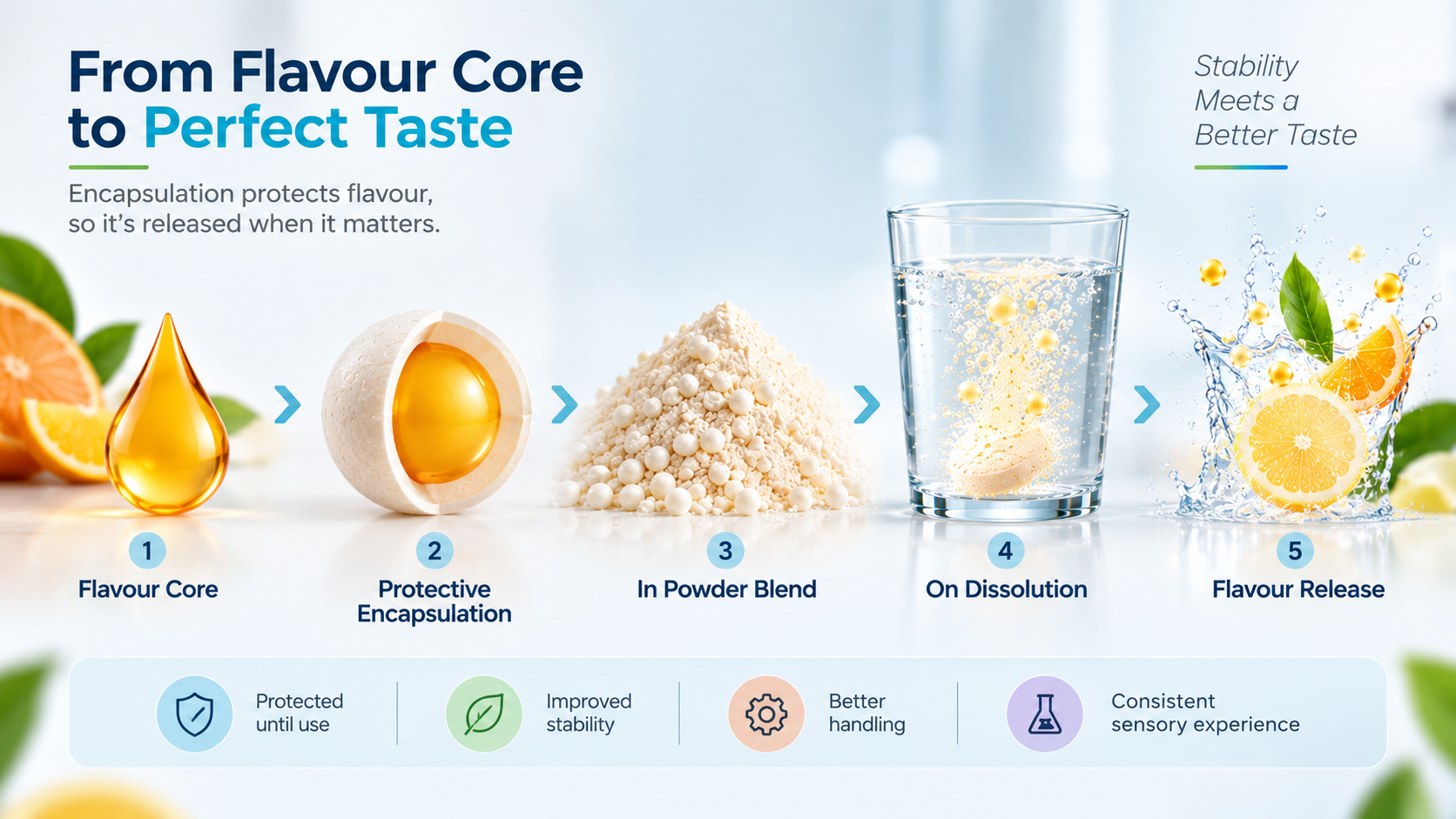
An encapsulated flavour system is designed to protect flavour compounds before they reach the point at which their sensory contribution is required.
During manufacturing, the encapsulating matrix can help reduce direct exposure between the flavour and surrounding ingredients. During storage, it may provide additional protection against environmental factors that could affect flavour quality. When the final product is dissolved or consumed, the flavour is released to contribute to the intended sensory profile.
This makes encapsulation particularly relevant for formulations where flavour performance must be maintained across several stages of the product lifecycle.
For example, an effervescent product must remain stable in its dry form while still delivering the intended flavour once it is dissolved in water. Similarly, an electrolyte powder must manage the sensory characteristics of minerals while maintaining flavour consistency across multiple servings.
The suitability of an encapsulated flavour for any application should be confirmed through formulation trials and sensory evaluation.
Flavour stability is an important consideration for products intended for extended storage and distribution.
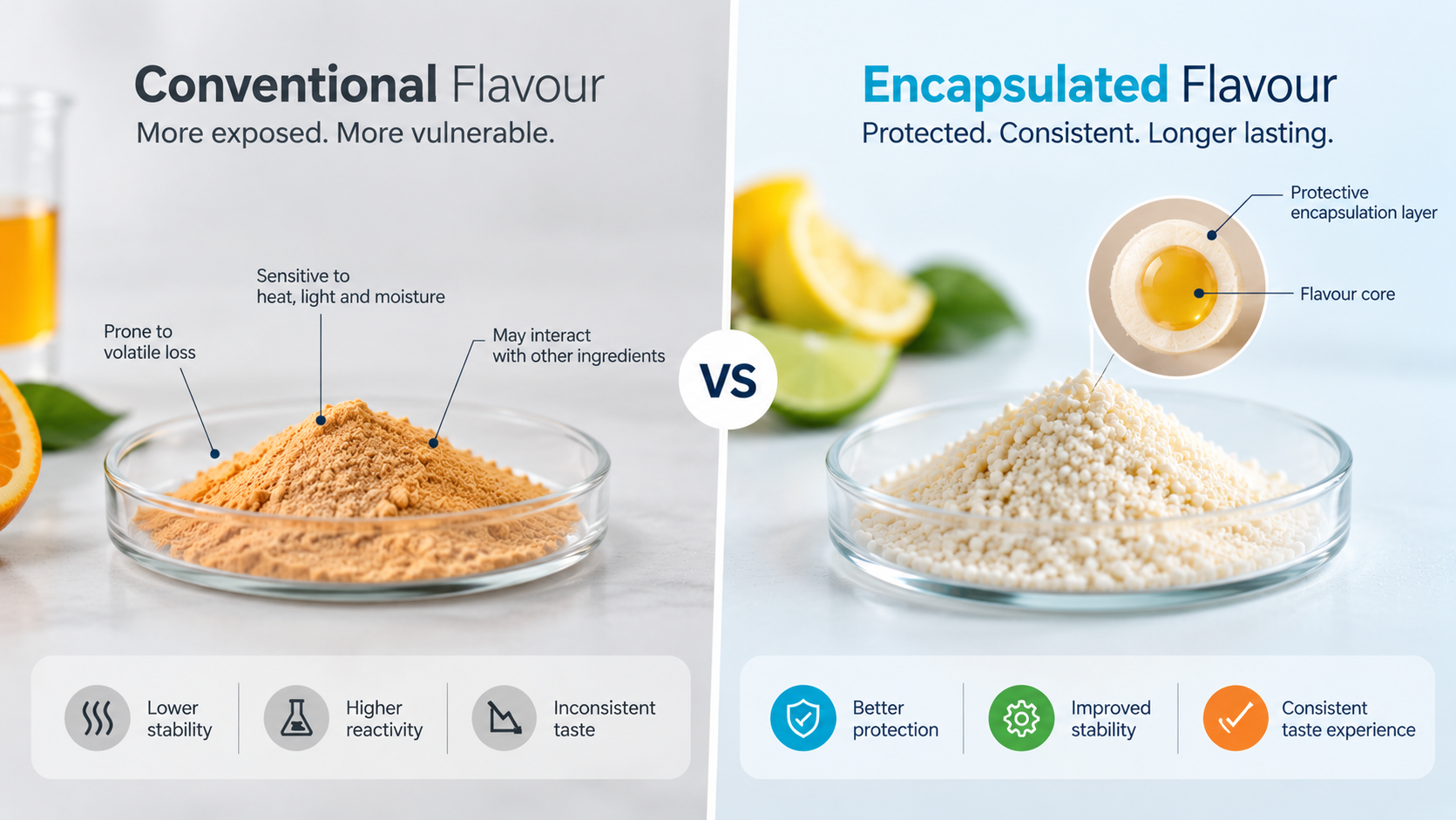
Volatile flavour compounds can be susceptible to environmental exposure. Heat, oxygen and moisture may contribute to changes in aroma and flavour intensity over time. The extent of this effect depends on the specific flavour composition, product formulation, packaging and storage conditions.
Encapsulation can provide a physical barrier around flavour components, helping reduce their exposure to the surrounding environment.
For manufacturers operating in regions with warm or humid climatic conditions, this can be particularly relevant. However, it is important to view encapsulation as one part of a broader stability strategy.
Ingredient selection, manufacturing controls, water activity, packaging design and storage conditions all influence the stability of the finished product. A technically appropriate flavour system should work alongside these factors rather than replace them.
Effervescent formulations are chemically active systems designed to produce a reaction when introduced to water.
Before consumption, however, the dry formulation must remain stable.
Acids and bicarbonates are commonly used to create the characteristic effervescence, while electrolytes, minerals and other functional ingredients add further complexity to the product matrix.
A carefully selected encapsulated flavour may help minimise unnecessary exposure between sensitive flavour compounds and surrounding ingredients during storage and processing.
The benefit is not that encapsulation eliminates every possible interaction. Instead, it can provide formulators with greater flexibility when developing products containing multiple functional components.
The final formulation should still undergo appropriate stability testing to evaluate compatibility and long-term performance.
Consistency is critical to consumer acceptance.
A product that tastes noticeably different from one batch to another—or from one serving to the next—can affect consumer confidence and brand perception.
Encapsulated flavours may help support consistency by protecting flavour compounds before use and improving their suitability for dry powder applications.
This can be particularly relevant for products manufactured at scale, where uniformity across blending, filling and packaging processes is essential.
However, sensory consistency depends on more than flavour technology alone. Particle distribution, blending parameters, dosage accuracy and product packaging all play a role.
The most effective approach is to evaluate flavour performance as part of the complete manufacturing and formulation process.
Taste masking is a common challenge in functional nutrition products.
Minerals, electrolytes and certain nutraceutical ingredients can contribute bitterness, metallic notes or other undesirable sensory characteristics. These sensory challenges may become more pronounced when products are formulated with high concentrations of active ingredients.
Microencapsulated flavours can form part of a broader taste-masking strategy by helping formulators develop a more balanced flavour profile.
However, encapsulation alone should not be positioned as a universal solution for taste masking.
Successful sensory optimisation typically requires careful consideration of the active ingredients, flavour profile, sweetener system, acidity, aroma and intended consumption format. The effectiveness of a flavour system should therefore be evaluated through application-specific sensory testing.
A technically successful product is one in which functional performance and consumer experience work together.
Environmental conditions can significantly influence dry product performance.
Humidity is particularly important for powders and effervescent systems because moisture exposure can affect physical stability and, in some cases, trigger undesirable reactions.
Flavour compounds may also be affected by environmental exposure.
A well-designed product therefore requires a comprehensive approach to stability. This includes selecting suitable ingredients, establishing appropriate manufacturing controls and using packaging designed for the product’s sensitivity and intended distribution environment.
Encapsulation can contribute to this approach by providing an additional level of protection for selected flavour components.
The actual benefit, however, must be demonstrated under relevant formulation and storage conditions. Stability testing remains essential.
PHS Lifesciences offers encapsulated flavour solutions through its FlavoPearl® platform for relevant food, beverage and nutraceutical applications.
Flavour requirements can vary significantly between products. A citrus profile suitable for an electrolyte drink may not perform in the same way within a protein formulation or nutraceutical sachet.
For this reason, flavour selection should begin with the application.
Factors such as active ingredients, dosage, processing conditions, desired sensory profile and shelf-life expectations should all be considered before selecting a flavour system.
The role of a technical ingredient partner is therefore not limited to supplying a flavour. It also involves understanding the formulation challenge and evaluating how an encapsulated flavour solution can fit within the complete product.
The first question should not simply be, Which flavour do we want?
A more useful starting point is to understand the formulation challenge.
Does the product contain ingredients with strong sensory characteristics? Will it be exposed to demanding processing conditions? Is moisture stability a critical concern? Does the product need to maintain flavour consistency throughout a long distribution cycle?
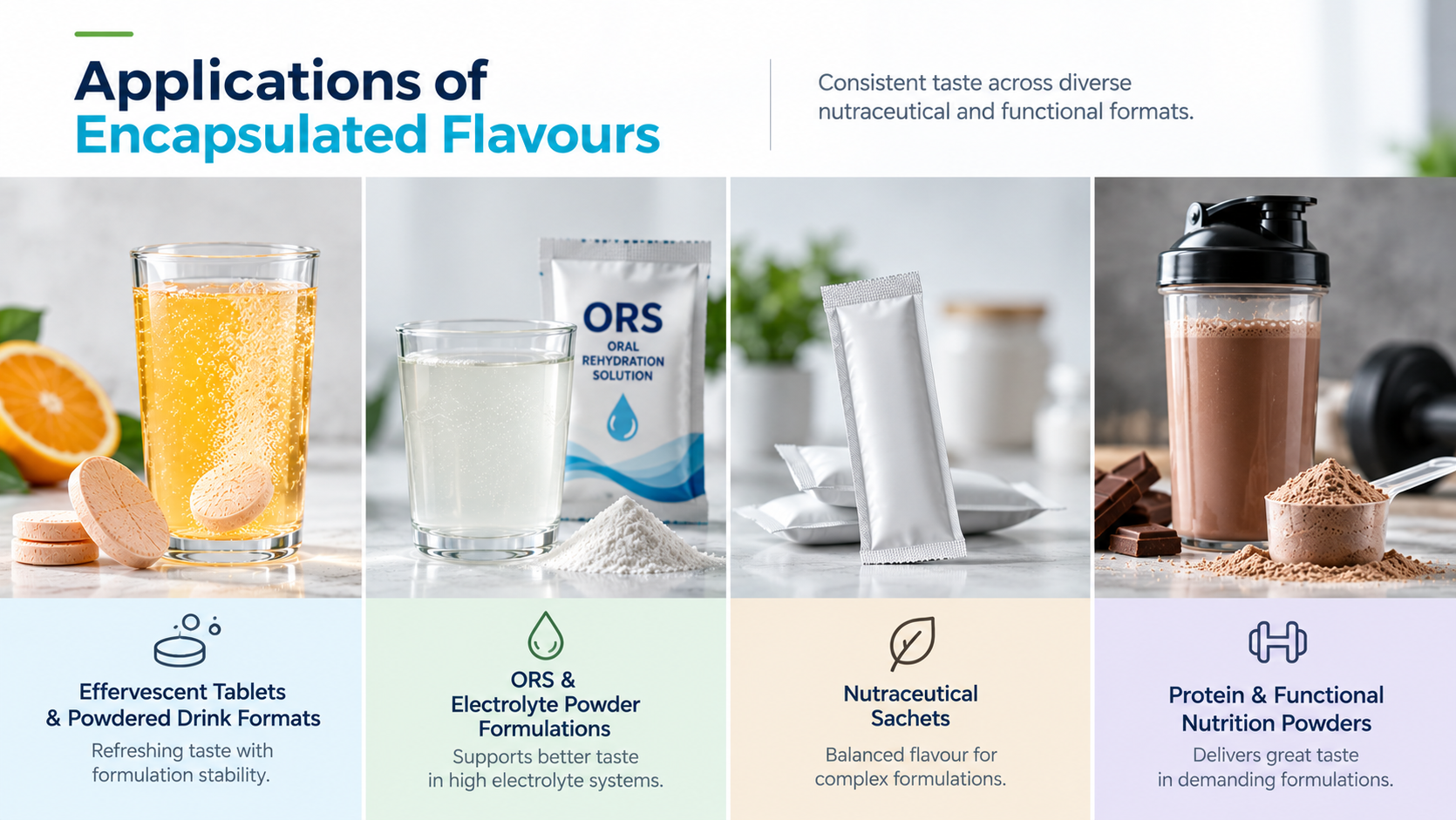
The final product format also matters. An effervescent tablet, ORS sachet, electrolyte powder and protein supplement each present different technical requirements.
Release behaviour should also be considered. The desired sensory experience depends on when and how the product is consumed. A flavour system should therefore be evaluated in the final application rather than assessed only as an individual ingredient.
Packaging is equally important. Even the most technically appropriate encapsulated flavour cannot compensate for unsuitable packaging or poor moisture protection.
For this reason, the selection process should involve formulation trials, stability evaluation and sensory testing.
The nutraceutical industry is evolving beyond basic functional claims.
Consumers increasingly expect nutritional products to be convenient, easy to consume and enjoyable from a sensory perspective.
This has increased the importance of formulation technologies that address both functional performance and consumer experience.
Microencapsulated flavours represent one of several technologies available to product developers working with complex formulations. By helping protect selected flavour components and supporting controlled flavour performance, encapsulation can provide greater flexibility when developing products containing challenging ingredients.
For manufacturers, this means flavour should be considered earlier in product development.
When flavour development begins only after the active ingredients and processing system have been finalised, the available options may become limited. Integrating sensory and flavour considerations during formulation development can help create a more balanced final product.
Developing a successful effervescent product, ORS formulation, nutraceutical sachet or functional powder requires more than combining the right active ingredients.
Flavour stability, ingredient compatibility, sensory performance, manufacturing conditions and storage requirements all contribute to the quality of the finished product.
Encapsulated flavours for effervescent and ORS formulations can provide an additional formulation tool where flavour protection, stability and controlled sensory performance are important.
The most effective solution will always depend on the complete product formulation.
For manufacturers developing electrolyte systems, nutraceutical powders, sachets or effervescent formats, evaluating the interaction between flavour technology and the wider product matrix is essential.
At PHS Lifesciences, encapsulated flavour solutions such as FlavoPearl® can be explored as part of an application-focused formulation approach. Final ingredient selection should be supported by technical evaluation, application trials and sensory assessment to determine suitability for the intended product.
Encapsulated flavours are flavour compounds incorporated within a protective material or matrix. The encapsulating structure can help protect flavour components from environmental exposure and may influence their handling, stability and release behaviour.
Effervescent formulations can contain acids, bicarbonates and moisture-sensitive ingredients. Encapsulated flavours may be considered where formulators require improved flavour protection and compatibility with dry processing conditions.
Encapsulated flavours can form part of a broader taste-masking strategy. Their effectiveness depends on the complete formulation, including the active ingredients, sweeteners, acidity and desired sensory profile.
They can be evaluated for ORS and electrolyte powder applications where flavour stability, sensory consistency and dry powder processing are important. Suitability should be confirmed through application-specific formulation and stability testing.
Conventional flavours are supplied in various formats, including liquid and dry forms. Microencapsulated flavours contain flavour compounds within an encapsulating matrix, which may provide additional protection and influence handling or flavour release.
Selection should be based on the complete formulation rather than flavour preference alone. Active ingredients, processing conditions, product format, packaging, storage requirements and the desired sensory experience should all be evaluated.