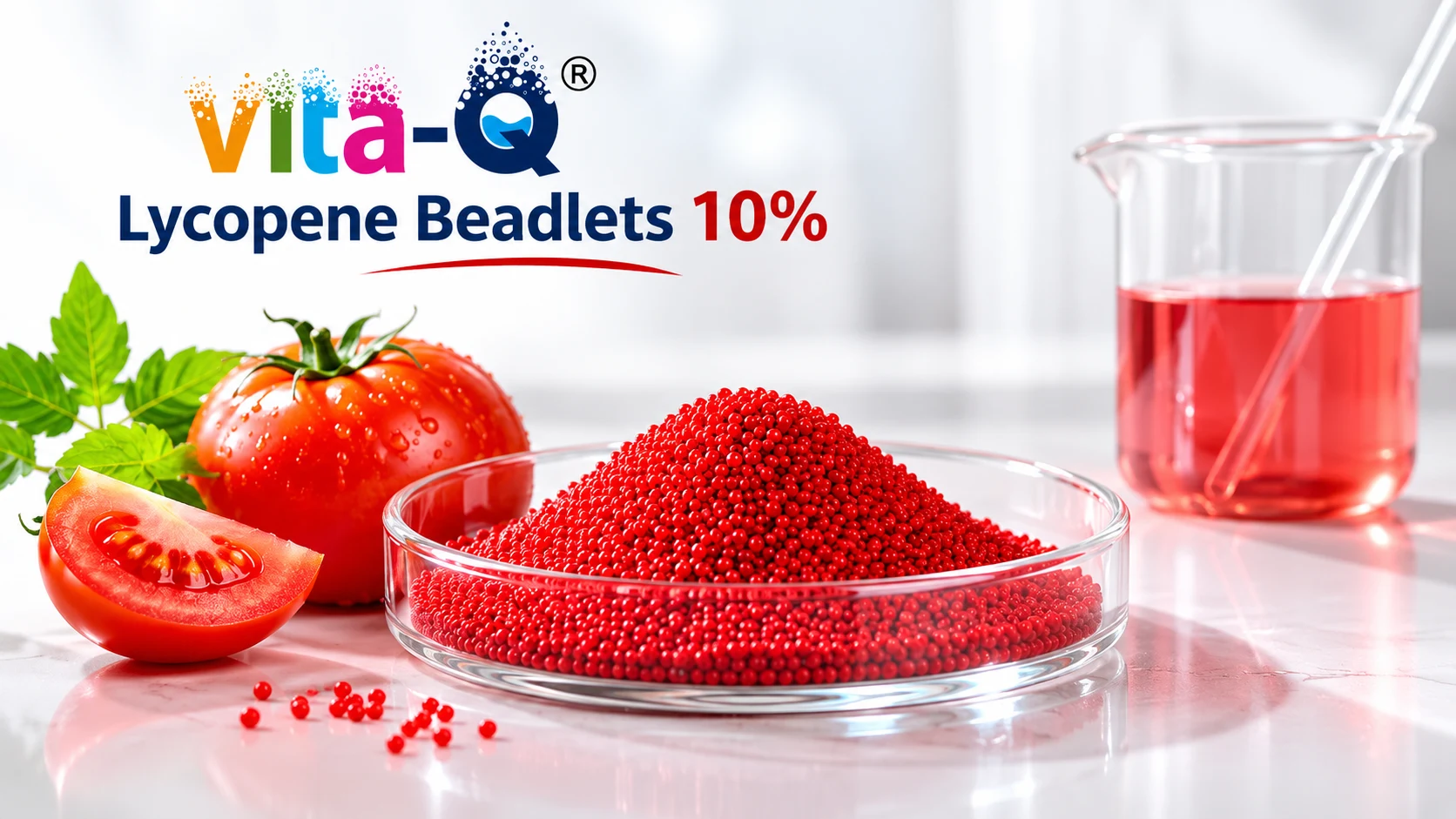
Why Is Lycopene Stability a Challenge for Supplement Manufacturers?
Microencapsulated lycopene offers a practical formulation approach for nutraceutical and functional food manufacturers seeking improved oxidative stability, cold-water dispersibility and manufacturing flexibility.
Lycopene is widely recognised for its antioxidant properties, but incorporating it into commercial food and nutraceutical formulations can present several technical challenges.
Although conventional lycopene is naturally rich in antioxidant potential, it is sensitive to environmental factors such as light, oxygen and heat. Its poor water solubility can also make uniform dispersion in aqueous formulations difficult. In addition, conventional lycopene extracts may introduce strong odour, oily mouthfeel, dusting and processing complications.
For nutraceutical manufacturers and functional food developers, these challenges can affect product consistency, manufacturing efficiency and formulation flexibility.
This is where microencapsulation technology offers a practical formulation approach.
Vita-Q® Lycopene Beadlets 10% by PHS Life Sciences are designed to address these challenges through a protective encapsulation system that converts lycopene into free-flowing, cold-water-dispersible beadlets.
The result is an ingredient format developed for improved oxidative stability, convenient processing, neutral sensory characteristics and compatibility with multiple dosage forms.
What Is Lycopene and Why Is It Used in Nutraceutical Formulations?
Lycopene is a naturally occurring red carotenoid pigment found primarily in ripe tomatoes, watermelon, pink grapefruit and guava.
Unlike beta-carotene, lycopene does not have provitamin A activity. Its molecular structure contains 11 conjugated double bonds, contributing to its ability to quench singlet oxygen and scavenge free radicals.
Since the human body cannot synthesise lycopene, it must be obtained through dietary sources.
Lycopene is widely incorporated into nutraceutical and functional food formulations because of its association with:
- Antioxidant support.
- Cardiovascular wellness.
- Prostate health.
- Cellular protection.
- Skin photoprotection.
However, its formulation characteristics require careful consideration. Conventional lycopene extracts can be difficult to handle because of their sensitivity to oxidation and limited water dispersibility.
Microencapsulated lycopene provides an alternative ingredient format for manufacturers seeking greater formulation flexibility.
For further scientific information on lycopene, its antioxidant properties and potential nutraceutical applications, explore the published research available on PubMed – National Library of Medicine.
What Is Vita-Q® Lycopene Beadlets 10%?
Vita-Q® Lycopene Beadlets 10% is a microencapsulated lycopene ingredient developed by PHS Life Sciences.
The product uses a protective hydrocolloid/polymeric matrix containing:
- Starch
- Gum acacia
- Maltodextrin
This encapsulation system protects the lycopene core and transforms the naturally water-insoluble ingredient into free-flowing, cold-water-dispersible beadlets.
The technology is designed to address common formulation challenges associated with conventional lycopene, including oxidation, poor dispersibility, handling difficulties and sensory limitations.
Its spherical beadlet structure also supports easier integration into dry blends, solid dosage formulations and functional beverages.
5 Key Benefits of Vita-Q® Lycopene Beadlets 10%
1. Improved Oxidative and Shelf-Life Stability
Lycopene contains 11 conjugated double bonds, which make it susceptible to oxidation and structural changes when exposed to light, oxygen and heat.
These environmental conditions can affect its stability and colour characteristics during storage and processing.
Vita-Q® addresses this challenge by sealing the active lycopene within a protective hydrocolloid/polymeric matrix.
This protective structure is designed to reduce exposure-related degradation and help maintain product quality throughout its shelf life.
For manufacturers, improved ingredient protection can be an important consideration when developing nutraceutical formulations with demanding storage and processing requirements.
2. Cold-Water Dispersibility for Aqueous Formulations
One of the biggest formulation challenges with conventional lycopene is its poor water solubility.
When introduced into aqueous formulations, conventional lycopene may separate, form surface rings or distribute unevenly.
Vita-Q® Lycopene Beadlets 10% are engineered to provide cold-water dispersibility (CWD).
The free-flowing beadlets enable more uniform dispersion in aqueous beverage systems and support formulation flexibility in products such as functional beverages and effervescent formulations.
The technology also supports enhanced emulsification and absorption characteristics in the gastrointestinal tract, as described in the product technical information.
3. Mechanical Stability During Manufacturing
Ingredient stability is not limited to storage. Manufacturing conditions can also affect the performance of sensitive ingredients.
During tablet production, ingredients may experience:
- High-pressure direct compression.
- Blending shear.
- Extrusion processes.
- Mechanical handling during processing.
Conventional lycopene powders may experience oil bleeding, sticking, dusting or surface speckling during tablet manufacturing.
Vita-Q® beadlets are engineered to withstand demanding mechanical processing conditions without beadlet rupture or oil bleeding under the intended processing conditions.
This makes them suitable for manufacturers looking for a lycopene ingredient compatible with direct-compression tablet production.
4. Neutral Taste and Odour
Sensory characteristics play an important role in the development of nutraceutical products.
Raw lycopene extracts may have a characteristic grassy or tomato-oleoresin odour and an oily mouthfeel. These characteristics can complicate product development, particularly for unflavoured or delicately flavoured formulations.
Vita-Q® Lycopene Beadlets 10% offer neutral taste and odour characteristics.
This helps manufacturers incorporate lycopene into formulations without introducing the characteristic sensory profile associated with conventional extracts.
5. Versatile Formulation Compatibility
Manufacturers often require ingredients that can be incorporated into different product formats without extensive reformulation.
Vita-Q® Lycopene Beadlets 10% offer compatibility with multiple dosage forms, including:
- Direct-compression tablets.
- Hard-shell capsules.
- Effervescent tablets.
- Functional beverages.
- Dry mix powders and sachets.
- Gummies and chewables.
Their spherical, free-flowing and dust-free structure supports handling and integration into different manufacturing processes.
This versatility makes Vita-Q® a formulation option for nutraceutical brands and functional food developers exploring multiple delivery formats.
Conventional Lycopene vs Vita-Q® Lycopene Beadlets 10%
Choosing the right ingredient format can influence manufacturing efficiency, product appearance and formulation flexibility.
The following comparison highlights the differences described in the Vita-Q® technical product information.
| Parameters | Conventional Lycopene | Vita-Q® Lycopene Beadlets 10% |
|---|---|---|
| Appearance | Fine powder that may be sticky or staining | Spherical, free-flowing beadlets |
| Sensory profile | Characteristic odour | Neutral taste and odour |
| Water dispersibility | Water-insoluble | Cold-water dispersible |
| Processing | Potential dusting and oil bleeding | Designed for improved mechanical stability |
| Tablet manufacturing | May cause sticking and surface speckling | Designed for direct compression |
| Formulation flexibility | Requires careful handling | Suitable for multiple dosage forms |
What does this mean for manufacturers?
The difference is not simply the ingredient concentration. It is also the delivery format and the way the ingredient behaves during formulation and manufacturing.
Vita-Q® combines microencapsulation with cold-water dispersibility to address several practical limitations of conventional lycopene powder.
Applications of Vita-Q® Lycopene Beadlets 10%
The product is designed for manufacturers developing nutraceutical and functional food products across different dosage formats.
1. Nutraceutical Tablets
Vita-Q® beadlets are designed for direct compression and can be incorporated into tablet formulations.
Their mechanical stability supports manufacturing processes where compression pressure and blending conditions need to be considered.
2. Hard-Shell Capsules
The free-flowing beadlet format supports incorporation into hard-shell capsule formulations.
It also provides a convenient alternative to handling conventional fine lycopene powders.
3. Functional Beverages
Cold-water dispersibility makes Vita-Q® suitable for aqueous beverage formulations.
It supports more uniform dispersion compared with conventional water-insoluble lycopene formats.
4. Effervescent Tablets
Its cold-water-dispersible properties make the ingredient suitable for consideration in effervescent formulations.
5. Gummies and Chewables
Vita-Q® can also be incorporated into gummy and chewable product formats, subject to formulation compatibility and processing conditions.
6. Dry Mix Powders and Sachets
The free-flowing beadlet structure supports integration into dry premixes and sachet formulations.
Why Choose Microencapsulated Lycopene for Product Development?
For ingredient buyers and formulation specialists, selecting a raw material involves more than evaluating its active ingredient concentration.
They must also consider stability, handling, manufacturing compatibility, sensory characteristics and the final product format.
Microencapsulation helps address these considerations by surrounding sensitive ingredients with a protective matrix.
In the case of Vita-Q® Lycopene Beadlets 10%, the combination of starch, gum acacia and maltodextrin creates a beadlet system designed to provide:
- Protection against environmental degradation.
- Cold-water dispersibility.
- Improved handling characteristics.
- Mechanical stability during processing.
- Neutral taste and odour.
- Compatibility with multiple dosage forms.
These characteristics make microencapsulated lycopene a relevant ingredient format for manufacturers seeking to develop consistent and versatile nutraceutical products.
Why Consider PHS Life Sciences for Microencapsulated Lycopene?
Selecting an ingredient supplier requires attention to both product specifications and technical documentation.
PHS Life Sciences offers Vita-Q® Lycopene Beadlets 10% with a focus on microencapsulation-based formulation performance.
According to the product technical information sheet, the following documentation is available:
- Certificate of Analysis (COA) – on request.
- Material Safety Data Sheet (MSDS) – on request.
- Technical Data Sheet (TDS) – on request.
- FSSAI licence endorsement – available.
The technical information sheet also references FSSAI Schedule III, Part B, Sr. No. 109, in the October 2022 compendium. Manufacturers should verify current regulatory requirements, permitted applications and applicable usage limits before commercial formulation.
For product specifications and technical documentation, contact the PHS Life Sciences team.
Manufacturers should refer to the latest regulations and applicable guidelines published by the Food Safety and Standards Authority of India (FSSAI) before commercial product formulation.
Frequently Asked Questions (FAQs)
1. What are Vita-Q® Lycopene Beadlets 10%?
Vita-Q® Lycopene Beadlets 10% are microencapsulated lycopene ingredients developed by PHS Life Sciences. They are designed to provide improved oxidative stability, cold-water dispersibility, neutral sensory characteristics and formulation versatility.
2. What is the main advantage of microencapsulated lycopene?
Microencapsulation provides a protective matrix around the lycopene core. This helps address challenges related to oxidation, environmental exposure, processing stability and handling.
3. Are Vita-Q® Lycopene Beadlets water-soluble?
No. They are described as cold-water dispersible (CWD), not water-soluble. This distinction is important: dispersibility allows the beadlets to distribute more uniformly in aqueous formulations without claiming that lycopene itself becomes water-soluble.
4. Which materials are used in Vita-Q® Lycopene Beadlets?
The encapsulating materials listed in the technical product information are starch, gum acacia and maltodextrin.
5. Can Vita-Q® Lycopene Beadlets be used in tablets?
Yes. They are designed for direct-compression tablet manufacturing and are engineered to withstand mechanical processing conditions without beadlet rupture or oil bleeding.
6. Can microencapsulated lycopene be used in functional beverages?
Yes. Vita-Q® Lycopene Beadlets offer cold-water dispersibility, supporting their use in aqueous functional beverage formulations.
7. Are Vita-Q® Lycopene Beadlets suitable for gummies?
Yes. Gummies and chewables are among the compatible dosage forms listed in the product technical information. Final suitability should be established through formulation trials.
8. Do Vita-Q® Lycopene Beadlets have a strong taste or odour?
The product is specified as having neutral taste and odour characteristics, making it suitable for unflavoured and delicately flavoured applications.
9. What is the typical daily lycopene formulation range mentioned in the technical sheet?
The technical sheet references typical formulations containing 2 mg to 15 mg of active lycopene daily. This is technical product information, not an individual dosage recommendation. Actual formulation levels must be determined according to applicable regulations, product requirements and scientific substantiation.
10. How can manufacturers obtain Vita-Q® Lycopene Beadlets technical documentation?
Manufacturers can contact PHS Life Sciences to request available product documentation, including the COA, MSDS and TDS.
Develop Better Lycopene Formulations with Vita-Q®
Lycopene offers valuable formulation opportunities in nutraceuticals and functional foods, but its sensitivity to environmental conditions and poor water dispersibility can create challenges during product development.
Vita-Q® Lycopene Beadlets 10% address these challenges through microencapsulation technology, cold-water dispersibility and a free-flowing beadlet structure.
For manufacturers developing tablets, capsules, functional beverages, effervescent products, gummies and dry mix formulations, Vita-Q® provides an ingredient format designed to support formulation flexibility and manufacturing performance.
Looking for a microencapsulated lycopene ingredient for your next formulation?
Connect with PHS Life Sciences to explore Vita-Q® Lycopene Beadlets 10% and request the technical product documentation.
Contact: marketing@phslifesciences.com
Website: https://phslifesciences.com/